
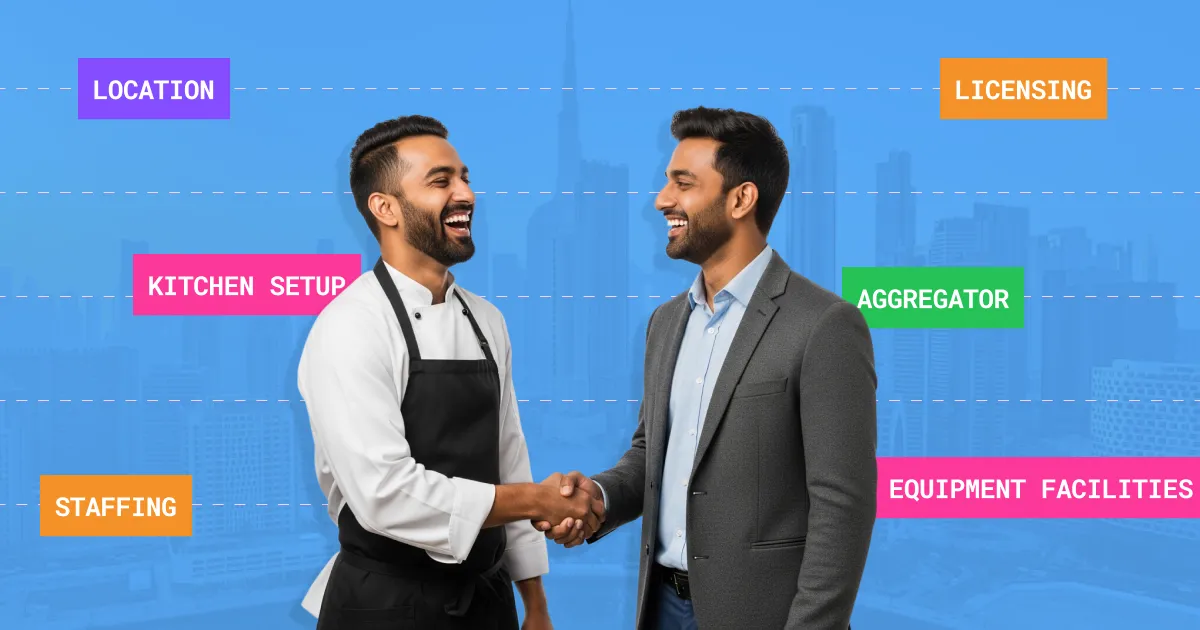
A kitchen can look fully equipped, clean, and available next week, yet still be the wrong place to launch a delivery brand. In Dubai, a commercial kitchen rental Dubai decision affects far more than monthly rent. It determines what you can license, how quickly you can activate delivery platforms, whether your menu can be produced consistently, and how much margin remains after fixed operating costs.
For delivery-first founders, the goal is not simply to find an available kitchen. It is to secure a production base that supports controlled execution from the first order through the first growth cycle. That requires checking the commercial model, technical fit, legal readiness, and operating constraints before committing.
Commercial kitchens in Dubai are offered through several models: shared-use facilities, dedicated cloud-kitchen units, managed kitchens, restaurant subleases, and independent fitted spaces. Each can work, but each creates different levels of control, capital exposure, and operational responsibility.
A shared kitchen may reduce upfront investment and give a new operator access to existing extraction, cold storage, cleaning systems, and utility infrastructure. It can be a sensible entry point for a narrow-menu concept that is testing demand. The trade-off is reduced control over access, storage, cleaning standards, delivery-driver congestion, and peak-hour production capacity.
A dedicated cloud-kitchen unit gives stronger brand separation and more reliable workflow control. It is often better suited to operators planning multiple delivery platforms, larger order volumes, or menus that require dedicated equipment. However, a dedicated unit can carry higher rent, fit-out commitments, deposits, and minimum contract periods. The kitchen must earn that fixed cost through realistic order volume, not optimistic forecasts.
Using unused capacity in an existing restaurant kitchen can be highly efficient when the layout, equipment, and licensing structure support the proposed delivery concept. It is not automatically low risk. Restaurant teams may be optimized for dine-in service, not delivery packing, dispatch timing, aggregator menus, or all-day production. If the new brand competes for the same prep tables, staff attention, refrigeration, and peak-hour equipment, the apparent savings can disappear quickly.
The right model depends on your target order volume, menu complexity, budget, operating hours, and appetite for direct management. The property search should begin only after those decisions are documented.
Do not rely on a broker description or a verbal assurance that a kitchen is “license-ready.” Ask for documentation and confirm how the facility structure applies to your business activity, brand, and operating model.
First, establish whether the facility can support the legal and food-safety approvals needed for your intended activity. A kitchen approved for one operator or food category may not automatically be suitable for every concept. The exact requirements depend on your company setup, product type, production process, storage needs, and whether you will operate under your own entity or within a managed facility structure.
Then check the lease or service agreement closely. The commercial difference between a rental agreement and a managed-kitchen agreement matters. One may include utilities, cleaning, waste removal, pest control, grease-trap maintenance, security, equipment servicing, and shared staffing support. Another may charge for each item separately. A low headline rate can become expensive once operating add-ons are applied.
Before signing, verify these practical points:
These are not administrative details. They shape service speed, food quality, labor productivity, and the ability to protect marketplace ratings.
A kitchen should be evaluated using production scenarios, not a generic equipment list. A pizza concept, a premium meal-prep brand, a fried-food menu, and an Asian wok operation can all require very different heat capacity, holding space, ventilation, prep flow, and packaging stations.
Build a simple production map for your busiest expected hour. Track where ingredients are received, stored, prepped, cooked, held, packed, checked, and handed to delivery drivers. Then walk that sequence inside the proposed kitchen. If cooks cross the packing line, if hot food waits beside cold ingredients, or if drivers collect from the same narrow route used for receiving stock, the workflow will create avoidable friction.
Equipment capacity matters as much as equipment presence. A facility may advertise fryers, ovens, chillers, and freezers, but the question is whether those assets can support your order mix at peak demand. Ask how many other operators share them, what happens when equipment fails, and whether you can bring in additional equipment. Also review the electrical load and extraction constraints before adding high-demand appliances.
Packaging deserves the same attention. Delivery food is judged after transit, not at the pass. You need sufficient counter space for packing, labeling, order checks, tamper seals, and courier handoff. A well-designed packing station reduces missing items, protects food presentation, and improves the consistency that customers reward with higher ratings.
Rent is only one line in the unit economics. A disciplined feasibility model should combine fixed kitchen costs with variable operating costs and expected marketplace deductions.
Start with the monthly all-in facility cost: rent or service fee, utilities, cleaning, storage, maintenance, waste handling, equipment rental, deposits amortized over the contract term, and any mandatory facility charges. Add direct labor, ingredients, packaging, platform commissions, promotional spend, refunds, payment fees, and delivery-related costs where applicable.
Then calculate the order volume required to cover fixed costs. This is where many launches become exposed. If a kitchen requires a high daily order count to break even, but the concept has no established customer base, no platform visibility plan, and no proven average order value, the lease may be too large for the launch stage.
Use conservative assumptions. Model a ramp-up period rather than assuming full sales in month one. Test a lower average order value, higher food cost, and a meaningful refund allowance. The model should show the impact of a weaker-than-planned rating or slower platform traction, because those issues directly affect conversion and repeat ordering.
A smaller, operationally compatible kitchen is often commercially stronger than a larger space that forces the business to chase volume before its menu and marketplace positioning are stable.
A delivery-only business is not judged only by its food. Customers experience search placement, menu clarity, estimated delivery time, packaging condition, item accuracy, and issue resolution. Your kitchen location and dispatch process influence several of those factors.
Review the delivery zones that the facility can serve within your target preparation and travel times. A central location is not always the best location if the concept’s demand is concentrated elsewhere or if traffic conditions make key neighborhoods difficult to reach at meal peaks. Match the kitchen to the customer catchment, not simply to a familiar business district.
Observe driver flow during active periods. Are riders able to park or wait without blocking operations? Is there a clear collection point? Can the team identify orders quickly? A crowded, poorly organized pickup process can extend handoff times and increase the risk of cold food, driver complaints, and order errors.
Also plan the platform launch before the kitchen opens. Menu photography, category placement, pricing, modifiers, prep-time settings, operational hours, and promotional rules should be prepared as part of the launch plan. A ready kitchen without an organized aggregator setup is still not ready to generate revenue.
The best rental agreement protects your ability to adjust. Early-stage delivery brands often need to refine the menu, change operating hours, add equipment, increase storage, or launch a second virtual brand after the first brand proves demand. Ask whether the facility can accommodate these changes and what approvals or charges apply.
For operators with limited launch experience, coordinated execution is usually more valuable than a quick property handover. FoodWork approaches kitchen sourcing as part of a wider commercial plan: feasibility, licensing coordination, kitchen workflow, platform onboarding, and post-launch performance management should work as one system. That reduces the gaps that occur when a broker, a consultant, a kitchen operator, and a marketplace team each manage only one part of the launch.
A commercial kitchen is not merely a place to cook. It is the production engine behind your ratings, margins, delivery promise, and ability to scale. Choose the space only when the numbers, approvals, workflow, and marketplace plan support the same operating reality.

Get clarity before you commit capital.

+971 52 288 5400
2101, Court Tower, Business Bay, Dubai UAE
hello@foodwork.ae
© 2026 FoodWork. All rights reserved
