
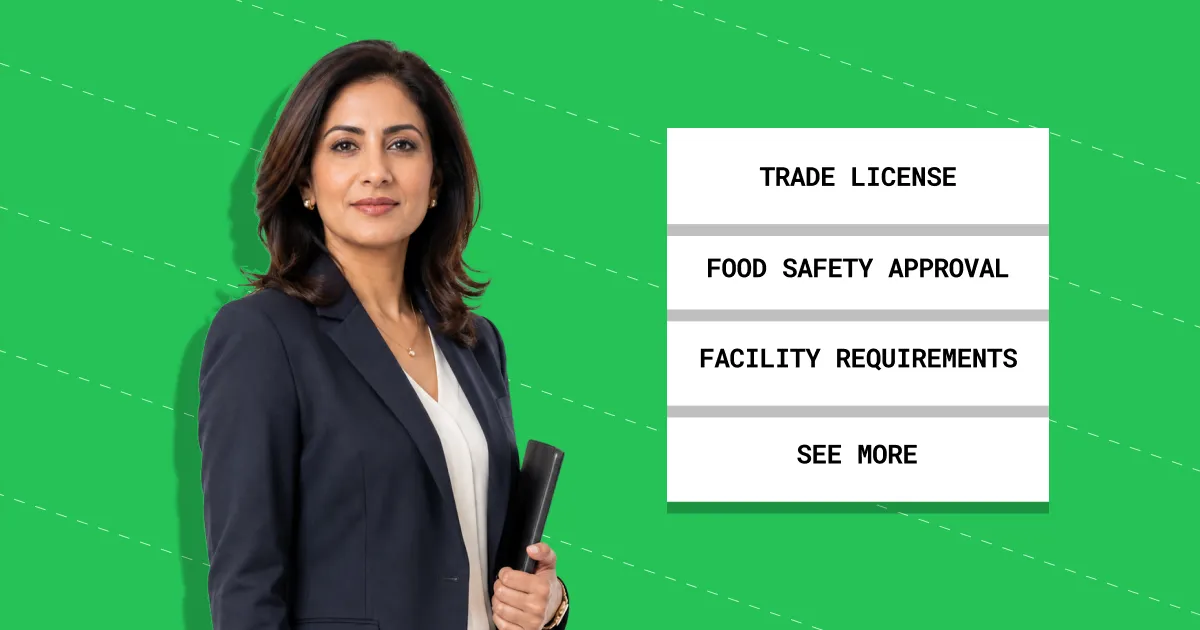
Cloud kitchen license requirements in Dubai fall into three groups: a trade licence with a food activity, food safety approval for the premises, and compliance for the kitchen itself covering extraction, hygiene and civil defence. Missing any one of them stops trading, whatever the lease says.
A delivery brand can have a strong menu, a capable chef, and demand on the major apps, yet still lose months and capital before its first order. The reason is usually not food. It is an unstructured setup process. Understanding cloud kitchen license requirements Dubai is the starting point for a controlled launch because your legal activity, kitchen location, food-safety approvals, and operating model must align before you commit to a lease, fit-out, or platform onboarding.
For founders, restaurant operators, and investors, the objective is not simply to obtain a trade license. It is to establish a legally compliant production operation that can meet delivery demand, pass inspections, onboard staff, and trade reliably from day one.
A cloud kitchen is a food-production business with no traditional dine-in service. It may run one delivery-only concept, several virtual brands from the same kitchen, or a managed production facility serving multiple operators. The licensing route depends on the exact model, but it generally combines a commercial license with food-business approvals.
In mainland Dubai, the trade license is typically issued through the Dubai Department of Economy and Tourism, commonly known as DET. Food-related approvals sit with Dubai Municipality’s food-safety function. If the operation is based in a free zone, the free-zone authority issues the company license, while food safety, premises, and operational approvals still need to be considered within that location’s framework.
The important decision comes before the application: choose an activity that accurately reflects what the business will do. A delivery-only restaurant concept, a central production kitchen, a catering activity, and a shared-kitchen operator can have different requirements. Adding a virtual brand to an existing licensed restaurant may be more straightforward than launching a separate production entity, but only if the existing kitchen, activity, and capacity support it.
Do not choose an activity based only on the lowest setup cost or a generic business description. A mismatch can create problems when you seek kitchen approval, sign supplier agreements, add partners, or onboard delivery platforms.
The process is best handled as a sequence rather than a document chase. First establish the legal entity and commercial activity. Then secure a suitable premises arrangement. After that, obtain the technical and food-safety approvals needed to operate from the site.
The legal setup normally begins with reserving a trade name, selecting the legal structure, identifying shareholders and managers, and applying for initial approval. Required documents vary by ownership structure and jurisdiction, but founders should expect to provide passport copies, visa or Emirates ID details where applicable, shareholder documents for corporate owners, and constitutional documents for the entity.
At this stage, clarify whether the company will only operate its own brands or also provide kitchen space, production, or management services to other brands. These models carry different commercial and compliance implications. Getting this right early prevents expensive amendments after launch.
A cloud kitchen cannot be licensed from just any commercial unit. The premises must be appropriate for food production and acceptable to the relevant authorities. For a mainland operation, this generally means a valid tenancy arrangement and location documentation, often including Ejari where applicable. Free-zone operators follow the documentation process set by their authority.
The kitchen should be assessed before signing a long lease. A lower rental rate is not a saving if the unit requires major exhaust works, grease management, drainage changes, electrical upgrades, fire-safety modifications, or a full redesign to achieve approval.
This is where a feasibility review has commercial value. The right site is not simply one that can be licensed. It should also support the intended cuisine, number of brands, production volume, dispatch flow, rider access, storage needs, and delivery radius.
Dubai food-safety requirements focus on how food moves through the operation. Authorities will assess whether the layout supports hygienic receiving, storage, preparation, cooking, packing, cleaning, and waste handling. A cramped kitchen may look workable on a floor plan but fail operationally once dry stock, chilled ingredients, packaging, staff movement, and delivery pickup are added.
A practical layout separates raw and ready-to-eat food handling, provides adequate handwashing facilities, supports temperature-controlled storage, and allows cleanable surfaces and logical cleaning workflows. Ventilation, drainage, pest control, waste handling, and equipment placement must also be addressed.
For new sites and major fit-outs, technical drawings and equipment details are commonly reviewed before the kitchen is completed. This approval-before-build discipline matters. Altering a finished kitchen to fix a rejected workflow or missing service point is slower and more expensive than resolving it at design stage.
Food approval is only one part of site readiness. Depending on the premises and scope of works, fire and life-safety compliance may require review and approvals through the relevant building-management, landlord, and civil-defense processes. Exhaust systems, gas installations, fire suppression, emergency access, and occupancy conditions can all affect the project timeline.
Treat these as critical-path items, not construction details to solve at the end. A kitchen may be commercially ready but unable to open if final site approvals are delayed.
The business also needs a compliant team. Food handlers require the applicable health documentation and training before they begin production. Managers should establish documented controls for receiving, storage temperatures, cleaning, allergen handling, traceability, pest management, and waste removal.
This is not paperwork for its own sake. Delivery operations can create quality failures quickly because food may travel 20 to 40 minutes before it reaches the customer. Weak holding procedures, poor packing discipline, or poor temperature control will appear as complaints, refunds, and lower marketplace ratings.
Once the kitchen is built, equipped, staffed, and documented, it must be ready for inspection and the final food-operation approvals relevant to its model. The inspector will assess the actual operation, not the business plan. Equipment must be installed and functioning, storage must be organized, hygiene provisions must be in place, and workflows must match the approved setup.
A common launch mistake is to schedule inspection while contractors are still active or while core equipment has not arrived. This can lead to rework, repeat visits, and a delayed opening. Build a realistic readiness checklist around the inspection date rather than treating it as an administrative appointment.
The exact checklist will vary, but a well-managed project prepares the company and site file in parallel. This typically includes shareholder and manager identification documents, legal-entity paperwork, the proposed trade activity, trade-name and initial-approval records, and the tenancy or facility agreement.
For the kitchen, keep architectural and MEP drawings, equipment schedules, layout plans, contractor details, building approvals, and food-safety submissions organized in one controlled file. For operations, prepare staff records, supplier details, sanitation procedures, temperature logs, pest-control arrangements, and product information.
Centralized documentation is more than administrative discipline. It reduces contradictions between the license application, kitchen drawings, supplier setup, and delivery-platform profile. When several parties are involved – landlord, contractor, licensing agent, kitchen operator, brand owner, and aggregator – unclear ownership of these files causes delay.
There is no universally best licensing route. Mainland can suit brands seeking broader operating flexibility and a direct Dubai commercial footprint. A free zone can be attractive where its facilities, ownership structure, and commercial terms match the model. The trade-off is that each jurisdiction has its own process, facility rules, and practical limitations.
A shared or managed kitchen can reduce upfront capital and shorten the route to launch because core infrastructure may already be approved and operational. However, founders should confirm exactly what is included: license support, storage, equipment access, staffing, cleaning, utilities, dispatch space, and brand separation. Low entry cost can become high monthly cost if the commercial model limits margin or capacity.
Existing restaurants have another option: use spare production capacity to create a delivery-only virtual brand. This can be capital-efficient, but only after validating whether the current kitchen has enough labor, equipment, prep space, and peak-hour capacity. Adding orders to an already strained operation can damage both the new brand and the restaurant’s existing reputation.
A licensed kitchen is not automatically a revenue-ready kitchen. Delivery platforms will still require accurate business documents, bank and tax information where applicable, menus, product images, operating hours, packaging standards, and reliable dispatch procedures. The menu must be engineered for travel, not just for dine-in presentation.
Before going live, test production times, packaging performance, item availability, order acceptance, rider handoff, and customer-support escalation. Track cancellation rate, preparation time, refund reasons, rating trends, and item-level profitability from the first weeks. These metrics show whether the operation is commercially stable, not merely legally open.
FoodWork approaches licensing as part of a broader execution plan: site viability, compliant setup, operational handover, and early marketplace performance should be coordinated as one launch program. Fragmenting those decisions often creates avoidable cost and slower revenue.
The most useful question is not, “How quickly can we get a license?” It is, “Will this licensed kitchen be capable of producing profitable, consistent delivery orders at the volume we intend to sell?” Build the answer into the project before signing the lease.
The most common error is signing a lease before confirming the unit can be approved for food production. A building without food use, adequate extraction or civil defence compliance will not pass inspection, and the rent runs from handover regardless.
The second error is underestimating timelines. Approvals in Dubai are structured and predictable, but they are not instant, and each revision to a layout adds time. Requirements, checklists and inspection standards are published by Dubai Municipality, and using a shared or already approved kitchen shortens the route considerably.
Founders who treat cloud kitchen license requirements in Dubai as the first design constraint rather than a final formality launch faster and pay less dead rent. Our end-to-end setup service manages this sequence, and the setup cost calculator includes approvals in the launch budget.
No. Food produced for sale must come from an approved commercial kitchen that meets food safety requirements and holds the relevant approvals.
Both are used. The choice affects ownership structure, costs and where you can trade, so decide it alongside your delivery platform and expansion plans rather than in isolation.
Weeks rather than days for a straightforward application on an approved unit, longer where layouts need revision or the premises require upgrades.
Usually not a separate trade licence, but each brand must be registered correctly with the delivery platforms and produced from an approved kitchen.
Inspectors check layout compliance, hygiene practice, temperature control, storage, pest control and documentation, along with staff training and health cards.
It usually does, because the facility already holds premises approvals. You still need your own trade licence and staff compliance.
Our end-to-end cloud kitchen setup handles licensing, approvals and launch, and kitchen search and placement finds units that can actually be approved.
Get clarity before you commit capital.

+971 52 288 5400
2101, Court Tower, Business Bay, Dubai UAE
hello@foodwork.ae
© 2026 FoodWork. All rights reserved
