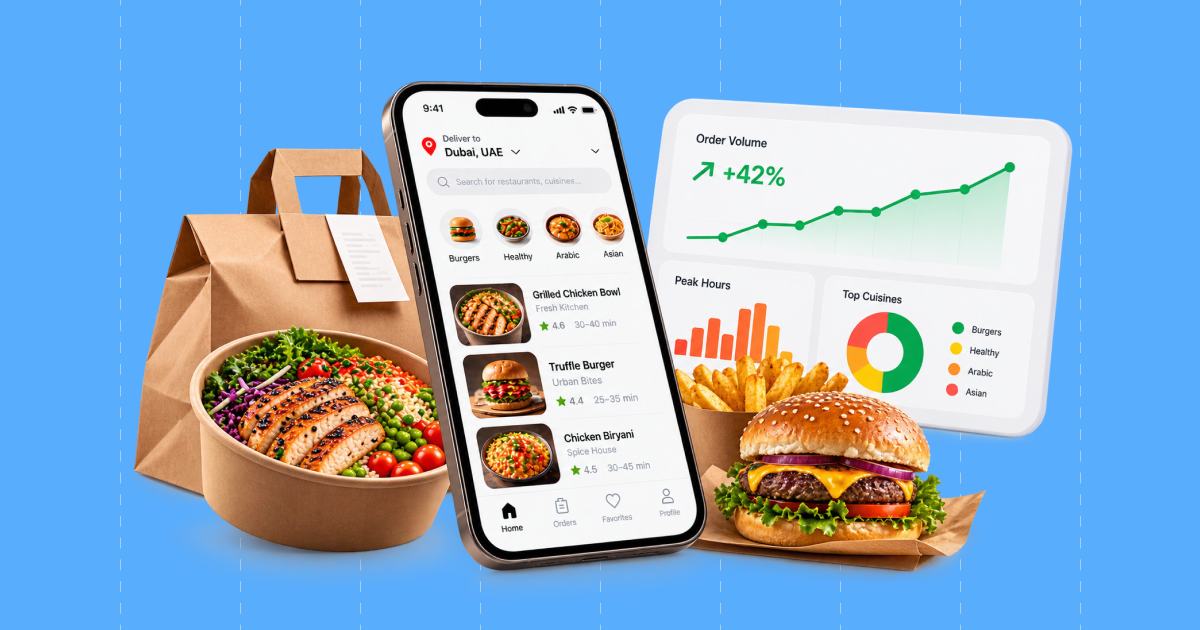
A delivery brand can receive more orders this month and still become less profitable. That is the operational reality behind the most consequential food delivery trends in the UAE. Higher platform demand does not automatically correct weak menu engineering, slow kitchen handoffs, poor packaging, or an unsustainable discount strategy.
For founders, restaurant operators, and investors, the opportunity remains substantial. But the winning model is no longer simply listing a menu on an aggregator and waiting for visibility. It is a controlled operating system: a commercially viable concept, delivery-ready food, accurate marketplace execution, and frequent improvement based on order-level data.
Food Delivery Trends That Matter to Operators
The delivery market is maturing. Customers have more choice, platforms have more sophisticated ranking systems, and operators have become more disciplined about the cost of acquiring and fulfilling each order. That shift favors businesses that can make faster, evidence-based decisions.
Convenience now includes reliability
Customers still value speed, but their judgment starts before the rider reaches the door. They notice whether the menu is easy to navigate, whether an item is available, whether preparation time is accurate, and whether the food arrives in the condition shown in the listing.
This makes operational consistency a commercial issue. A kitchen that accepts orders it cannot produce within the promised time may gain short-term sales but risk cancellations, poor ratings, lower conversion, and reduced platform visibility. The practical response is not to chase every peak-period order. It is to set realistic preparation times, manage capacity by station, and pause items that create recurring failure points.
Marketplace visibility is becoming a managed performance channel
Aggregator listings are not static storefronts. Their position is affected by conversion, availability, customer feedback, acceptance behavior, delivery performance, menu quality, promotions, and, in many cases, paid visibility tools. A good product hidden deep in a crowded cuisine category has a demand problem, not only a marketing problem.
Operators should treat each platform as a performance channel with its own operating rhythm. This means checking
search placement, conversion by menu category, item availability, ratings, cancellation reasons, and the commercial effect of promotions. The right intervention depends on the diagnosis. A weak conversion rate may point to unclear menu architecture or pricing. A falling rating may point to packaging, food hold time, or inconsistent execution during busy periods.
Value is replacing blanket discounting
Consumers remain price-aware, especially when delivery fees, service charges, and minimum-order thresholds raise the final basket value. Yet discounting every item is rarely a sound answer. It can erode contribution margin, attract low-loyalty demand, and make it difficult to return to sustainable prices.
Better value design starts with the customer occasion. A weekday lunch offer may need a complete, clearly priced meal. A late-night concept may need shareable bundles. A premium brand may need stronger visual cues, portion confidence, and add-ons rather than a deeper percentage discount.
The commercial question is simple: after food cost, packaging,
platform commissions, promotional support, labor, and kitchen occupancy, does the order still contribute meaningfully? If the answer is no, volume can amplify the problem.
Delivery-First Menus Are Getting Tighter
Large menus often look comprehensive to a founder and confusing to a customer. They also create inventory complexity, slower production, more stock-outs, and higher risk of quality variation. One of the clearest food delivery trends is a move toward menus designed around repeatable production and high-confidence demand.
That does not mean every concept should be minimal. It means each item needs a role. Some items build conversion, some raise average order value, and some create reasons to reorder. Items that neither sell reliably nor support the brand should be reviewed without sentiment.
Design around the journey, not the dine-in plate
Food travels through a different experience than it has on a restaurant table. Steam softens fried products, sauces separate, cold items warm up, and delicate presentation can collapse in transit. Delivery-first menu development requires testing the product after the expected travel window, not only at the pass.
Packaging should be selected as part of the recipe and workflow. Ventilation, compartment design, tamper evidence, labeling, and stackability affect both food quality and customer confidence. The lowest-cost container can become expensive when it drives complaints and refunds.
Portioning also deserves discipline. Inconsistent portions make food cost unreliable and ratings unpredictable. Standard specifications, weighed components where necessary, and simple assembly instructions give the team a repeatable standard during high-volume periods.
Virtual brands need genuine commercial separation
Using unused kitchen capacity for a virtual delivery brand can be an efficient growth move, particularly for established restaurants with available equipment, trained staff, and supplier relationships. However, a new logo and renamed menu are not enough.
A virtual brand needs a distinct customer proposition, viable demand within its target delivery radius, a menu that fits the existing kitchen without disrupting the core business, and separate platform positioning. If the concept competes directly with the host brand or creates bottlenecks at the same prep station, its additional revenue may come with disproportionate operational cost.
The best decisions are made before launch through a feasibility view that tests cuisine demand, competitor pricing, expected order mix, production requirements, and break-even volume.
Data Must Lead the Weekly Operating Review
Monthly reporting is too slow for a channel where ratings and availability can change in days. Delivery operators need a weekly review that turns data into a small number of accountable actions.
A useful dashboard should connect demand, execution, and profitability. At minimum, track these metrics consistently:
- Gross sales, completed orders, and average order value by platform
- Conversion and visibility indicators where platform data is available
- Acceptance rate, cancellations, preparation time, and stock-out frequency
- Rating trends, review themes, refunds, and complaint reasons
- Contribution margin by menu item, promotion, and channel
Numbers alone do not improve performance. The review must identify the operational cause behind movement. If average order value falls, check whether bundles lost visibility, add-on attachment declined, or promotional orders changed the mix. If ratings fall after 8 p.m., inspect staffing levels, dispatch handoff, and batch preparation during that period.
This is where controlled improvement cycles matter. Change one or two variables, set a measurement period, assess the result, and retain or reverse the change. Repricing an entire menu, changing packaging, launching multiple promotions, and adding new items at the same time makes it difficult to learn what actually worked.
Kitchen Capacity Is a Growth Constraint
Many delivery businesses underinvest in workflow design because the kitchen is not visible to the customer. Yet capacity determines whether demand becomes profitable revenue or a source of operational damage.
Map the order journey from
ticket acceptance to rider handoff. Identify the slowest station, the points where staff wait for equipment or components, and the steps that create remake risk. A bottleneck may be as specific as one fryer, one grill position, or a packaging counter shared by multiple brands.
There is a trade-off between utilization and resilience. Running every station at full capacity can look efficient, but it leaves no room for a late supplier delivery, a rush period, or a remake. A controlled launch should set capacity limits based on actual output tests, then increase exposure as the team proves consistency.
Staffing should follow order patterns rather than fixed assumptions. Delivery demand often peaks at times that differ from dine-in traffic. Schedules, prep plans, and shift roles should reflect those peaks, particularly on weekends, holidays, and major promotional days.
The Next Advantage Is Execution Discipline
The future of delivery is not defined by one platform feature or one viral cuisine. It is defined by operators who can connect commercial choices to kitchen reality. They know which items create margin, which platform actions improve discoverability, which complaints point to a process failure, and when not to scale an unstable operation.
For new UAE concepts, that calls for a structured launch rather than a fast listing. For existing restaurants, it calls for treating delivery as a managed business line rather than overflow revenue. FoodWork approaches this work as one coordinated system, from feasibility and kitchen setup through marketplace performance and revenue-focused improvement.
Before adding another brand, discount, or delivery zone, ask a harder question: can the current operation produce a consistently strong order at a margin worth protecting? The answer will usually point to the next useful decision.