
The busiest 20 minutes of service often determine whether a delivery brand earns repeat orders or absorbs refunds, poor ratings, and canceled tickets. A delivery kitchen workflow guide is not a set of generic kitchen rules. It is a commercial operating system that connects order acceptance, production, quality control, packaging, dispatch, and platform performance without creating bottlenecks.
For UAE operators, this matters because delivery demand can rise sharply around lunch, dinner, weekends, promotions, and weather changes. A kitchen that performs well at 15 orders per hour can fail quickly at 35 if stations, staffing, menu design, and courier handoff have not been planned together. The objective is not simply to cook faster. It is to produce accurate, high-quality orders at a predictable cost and a reliable marketplace delivery time.
Workflow design should begin with the orders you expect to receive, not with the equipment you already own. Review projected daily order volume, peak-hour concentration, average items per basket, cuisine complexity, delivery radius, and each platform’s preparation-time expectations. These inputs determine the number of workstations, the right staffing pattern, and the amount of ready-to-use mise en place required.
A common mistake is planning for average volume. If a brand expects 80 orders a day but receives 40 of them between 7:00 p.m. and 9:00 p.m., the kitchen must be designed for that two-hour peak. Average volume does not protect ratings during a rush.
Map the order journey from the moment a ticket appears to the moment a courier leaves. Every order should have a clear path: acceptance, ticket review, ingredient collection, cooking, assembly, quality check, packing, staging, and handoff. When two people assume someone else owns a step, errors become routine.
The best workflow is often less complicated than founders expect. It uses clear ownership, fixed station roles, controlled replenishment, and a visible queue. Complexity tends to increase when a kitchen adds menu items, platforms, and staff before its core production sequence is stable.
A delivery kitchen should be organized by movement of food, not by traditional hierarchy. The grill cook, fryer cook, expediter, and packer may each be skilled team members, but their positions must support a one-way order flow. Raw ingredients should not cross paths with finished food, and completed orders should not return to a cooking station for missing items.
A practical production line usually has four controlled zones: cold preparation and portioning, hot production, assembly and finishing, then packing and courier staging. The exact layout depends on the menu. A burger brand may need a tight grill-fry-assembly sequence, while a bowl concept may need a larger cold assembly station and a smaller hot finishing area.
The key question is where an order waits. If cooked food sits while a sauce, side dish, label, or bag is prepared, the bottleneck is not cooking capacity. It is assembly control. If packed orders wait for couriers in a crowded doorway, the handoff area is underdesigned. Measure waiting time at each stage for several peak periods before spending on more equipment.
Menus with multiple cooking methods introduce a trade-off. More choice can improve customer appeal, but every added station, modifier, and preparation path increases the chance of late orders. A delivery-first menu should favor components that can be batched, held safely for a defined period, and assembled consistently. This does not mean reducing the menu to basic items. It means designing dishes for repeatable production under pressure.
The kitchen’s true hourly capacity is set by its slowest constraint. It may be a single fryer, a limited combi oven, an underpowered packaging station, or one person handling both order acceptance and final checks. Identify that constraint before peak service, then decide whether to remove it through equipment, prep, staffing, or menu changes.
For example, if a signature item takes eight minutes in one fryer but all other components are ready in three, adding another packing employee will not improve ticket times. A second fryer basket, a revised batch plan, or a menu item with a different production method may have a greater commercial impact.
Prep is where delivery performance is won or lost before the first ticket arrives. Each ingredient needs a par level based on expected sales, recipe yield, shelf life, and replenishment time. Pars should be reviewed by daypart and weekday rather than set as one static number.
A Thursday dinner pattern may not resemble a Sunday lunch pattern. Promotions, payday periods, Ramadan, major events, and rain can alter demand quickly. Operators should track usage and waste together. Excess prep can protect service temporarily, but it raises food cost and creates quality risk. Too little prep produces stockouts, substitutions, and delayed orders.
Set clear prep cutoff times. The team needs to know which tasks must be completed before opening, which can be replenished during service, and which should never be started during a peak period. Portioning proteins, preparing sauces, labeling packaging, and restocking high-use ingredients should be completed before the rush whenever possible.
Recipe cards must support the workflow, not sit unused in a folder. They should specify portion size, build order, hold time, packaging requirement, allergen notes, and expected finished appearance. This gives new staff a production standard and gives managers a basis for coaching when quality slips.
The pass is the final control point before an order becomes a customer experience. One person should own final verification during peak hours, even in a small kitchen. That person checks ticket accuracy, item count, modifiers, seals, temperature-sensitive components, presentation, and bag labeling.
The quality check must be fast enough to protect dispatch time. That requires a short, repeatable process rather than a subjective inspection. If missing drinks or sauces are recurring, do not rely on staff being more careful. Change the pack sequence so those items are physically checked and placed in the bag at a defined step.
Packaging should be selected through delivery testing, not appearance alone. Fried food, sauces, cold drinks, desserts, and rice-based dishes all behave differently after 20 to 30 minutes in transit. Venting, compartment size, tamper seals, stacking strength, and condensation control can affect ratings as much as the recipe itself.
A useful discipline is to test the brand’s own orders across realistic delivery distances. Check temperature, texture, leakage, presentation, and whether each item remains easy to identify. The kitchen should optimize for the condition in which the customer receives the meal, not just how it looks on the pass.
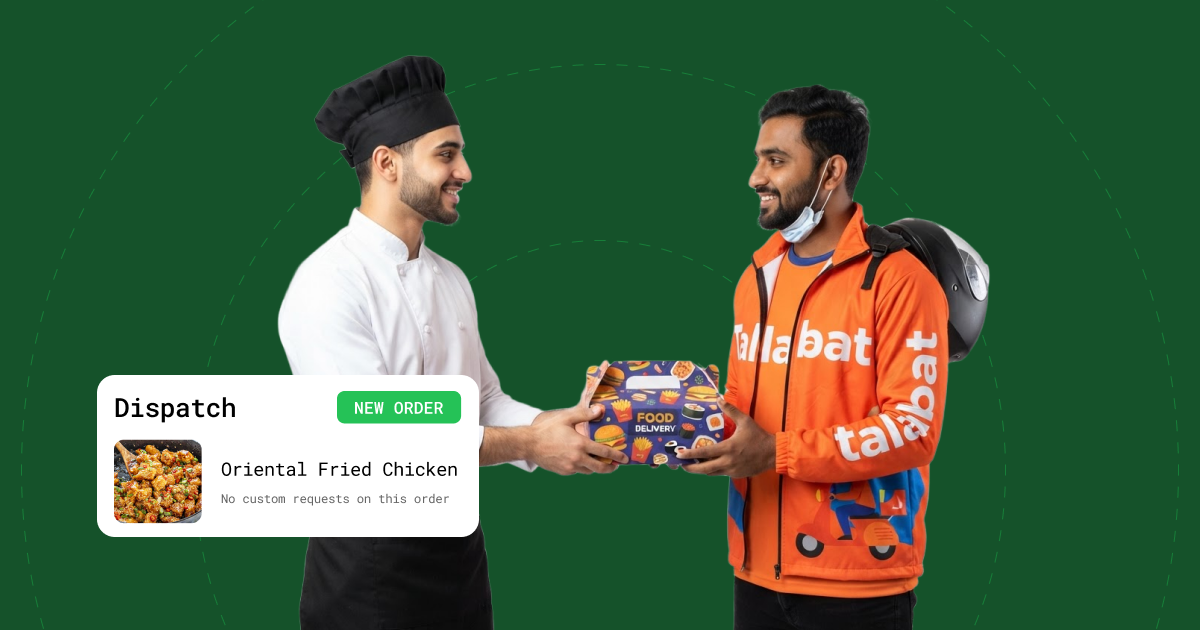
Couriers should not enter the production line, interrupt cooks, or search through unmarked bags. A designated staging area with visible order identifiers protects the kitchen team and reduces pickup confusion. It should be close enough to packing for fast transfer but separate enough to avoid congestion.
The handoff process should answer three questions immediately: Is the order ready? Which platform is it from? Has the correct courier collected it? Staff should confirm the order number before release and mark it as handed over according to the platform process.
Timing matters. Preparing an order too early can reduce food quality; preparing it too late can increase platform delays. Use actual pickup patterns to set preparation times. If couriers usually arrive before food is ready, the kitchen may need to shorten the displayed prep time only after improving production capacity. If food frequently waits on the shelf, investigate courier availability, delivery radius, and platform settings before blaming the kitchen.
Delivery operations need role clarity more than excessive headcount. During a busy period, define who owns hot production, assembly, packing, stock replenishment, order management, and issue escalation. In a smaller operation, one person may cover two roles, but that decision should be deliberate and tested against expected volume.
Managers should review performance daily using a short operating scorecard. Focus on orders accepted, canceled orders, average preparation time, late-order rate, customer rating, refund reasons, item availability, food cost, labor cost, and order volume by hour. These numbers show whether the problem is operational, commercial, or platform-related.
For instance, a falling rating with stable preparation times may point to food quality, packaging, or order accuracy. High cancellations may indicate unavailable menu items, tablet response failures, or unrealistic prep-time settings. A weak scorecard does not solve the issue, but it prevents teams from making expensive decisions based on assumptions.
Controlled improvement cycles work better than broad changes made during a difficult week. Choose one measurable issue, such as missing items or late handoffs, identify its root cause, test a process change, and review the result across enough orders to confirm it worked. Then move to the next constraint.
This approach also protects profitable operations from unnecessary disruption. Not every low rating requires a menu redesign, and not every slow shift needs more staff. Sometimes a revised station setup, a pre-labeled packaging shelf, or a tighter prep par is the right intervention.
A disciplined delivery kitchen workflow turns growth into a manageable operating decision rather than a daily firefight. When every order has a defined path and every recurring failure has an owner, the kitchen is better positioned to protect ratings, control costs, and accept more demand with confidence.

Get clarity before you commit capital.

+971 52 288 5400
2101, Court Tower, Business Bay, Dubai UAE
hello@foodwork.ae
© 2026 FoodWork. All rights reserved
