
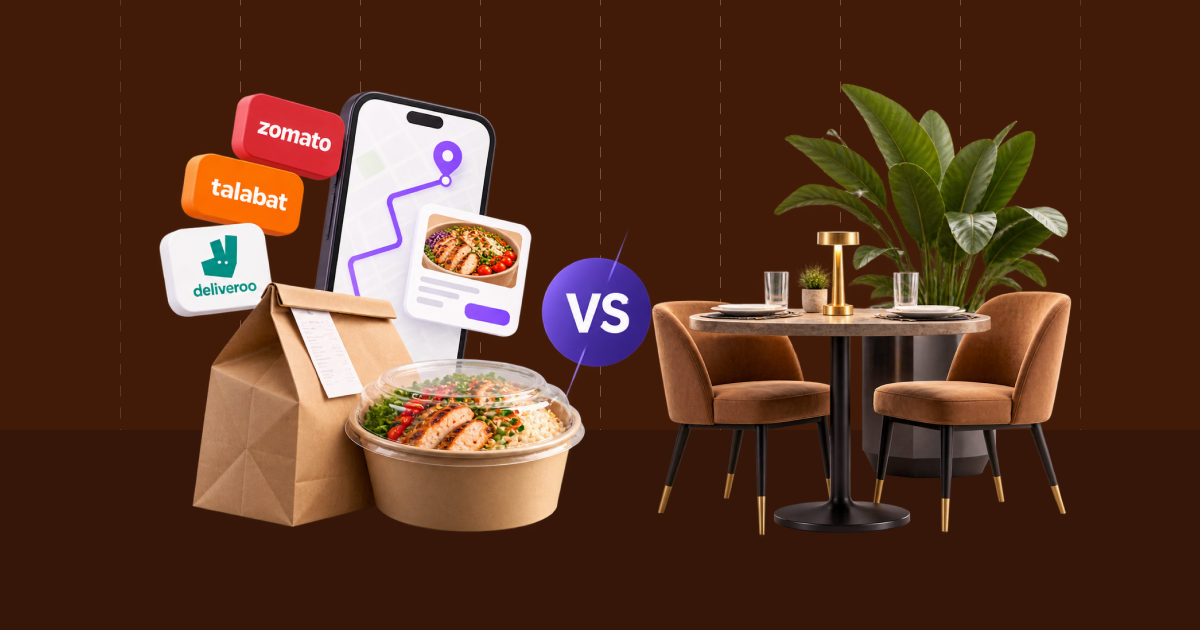
A restaurant can look busy, earn strong sales, and still be carrying the wrong cost structure. That is the real decision behind delivery only versus dine in. For UAE founders and operators, the question is not which format is more fashionable. It is which operating model can produce repeatable demand, protect contribution margin, and scale without adding uncontrolled complexity.
A dine-in site sells an experience alongside food. A delivery-only business sells food, speed, accuracy, packaging quality, and marketplace performance. Both can work. But they require different capital plans, kitchen systems, menus, teams, and definitions of success.
The most visible difference is occupancy cost. A dine-in restaurant needs a customer-facing location, fit-out, furniture, front-of-house staffing, utilities for the dining area, and often a more prominent address. These costs can be justified when the concept earns a meaningful premium through ambiance, service, and beverage sales. They become dangerous when seat utilization is inconsistent.
A delivery-only operation can begin with less capital because it removes the dining room. The kitchen can be built around production rather than guest circulation, table turnover, or street visibility. This gives founders more flexibility to test an area, launch from a managed kitchen, or use available capacity in an existing restaurant.
Lower entry cost does not automatically mean better profit. Delivery introduces aggregator commissions, promotional participation, delivery packaging, refund exposure, and the need for ongoing platform management. If menu prices and food costs are not designed for this channel, the business may generate orders while losing money on each one.
The correct comparison is contribution margin by order, not top-line revenue. Model the net sales received after commissions and discounts, then deduct food, packaging, direct labor, payment charges, and any order-specific costs. Only then can an operator see how much each format contributes toward rent, management, marketing, and profit.
In dine-in, the customer can forgive a short wait if the service is attentive and the atmosphere is right. In delivery, the food must survive the journey without that context. A great plate can arrive as a poor delivery product if it loses temperature, becomes soggy, leaks, or looks smaller than its menu image.
This changes menu development. Delivery-first menus need items that travel well, hold their quality, and can be produced consistently during a peak rush. Components should be controlled by portion, packaging must be tested with real delivery times, and modifiers should not create excessive kitchen friction.
Dine-in menus have different freedoms. They can include more delicate plating, made-to-order items that need immediate consumption, and products supported by tableside service. They may also rely more heavily on drinks, desserts, and impulse additions that are harder to reproduce through an aggregator interface.
For a restaurant adding delivery, copying the dine-in menu into a marketplace app is rarely the right move. The delivery menu should be engineered as its own commercial product, with selected bestsellers, disciplined bundles, clear photography, and prices that support channel costs.
A dining room creates operational complexity in public view. Hosts, servers, runners, guest recovery, reservations, cleaning, and table management all require coordination. Delivery removes these tasks, but it replaces them with another set of control points: order acceptance, prep-time accuracy, rider handoff, packaging checks, stock availability, and rating management.
These details matter because marketplace performance compounds. Slow acceptance, frequent cancellations, unavailable items, and weak ratings can reduce visibility. Lower visibility reduces orders, which weakens kitchen utilization and makes fixed costs harder to recover. A delivery business needs controlled improvement cycles, not occasional attention when sales decline.
A disciplined delivery operation tracks order volume by platform and daypart, average preparation time, cancellation rate, refund reasons, rating trends, item availability, basket size, and repeat-order behavior. These metrics identify the actual constraint. A low rating may be a packaging issue. Weak conversion may be driven by menu images or pricing. Poor dinner performance may point to a product-market mismatch rather than a marketing problem.
Dine-in operators also need measurement, but the signals are different. Covers, average check, table turn, labor per cover, reservation no-shows, beverage mix, and customer feedback guide decisions. The format rewards service consistency and local reputation, while delivery rewards discoverability, reliability, and fast operational response.
Delivery-only is often the stronger option when a founder needs to validate demand before committing to a large lease. It is also effective for focused concepts with high delivery suitability, such as bowls, burgers, pizza, Asian comfort food, desserts, and selected meal-prep formats.
It can be particularly valuable for established restaurants with underused kitchen capacity. A virtual brand can target a different occasion, cuisine, or price point without changing the core dine-in identity. The opportunity is real, but only if the added volume fits the existing production capacity. If the virtual brand slows core service or creates frequent stockouts, it will damage both businesses.
Delivery-only also suits operators who can treat marketplaces as active sales channels. That means maintaining accurate listings, responding to performance data, controlling promotions, and refreshing menus based on customer behavior. A listing is not a launch plan. It is the beginning of a revenue-management process.
The model is less attractive when the concept depends on premium hospitality, alcohol-led sales, celebration occasions, or visual presentation that cannot withstand transport. It is also risky when founders assume delivery platforms will create demand without a clear product position or adequate working capital.
Dine-in is the better choice when the physical environment is central to the value proposition. A destination restaurant, specialty café, family dining concept, or premium experience can earn more per guest because customers are paying for more than the meal. Strong beverage economics can materially improve the model as well.
A well-located dine-in site can build habitual traffic and direct customer relationships that are harder to own through third-party platforms. It can also create visibility that supports catering, events, and brand trust. But location quality must be measured against rent, access, parking, local demand, and the number of covers the site must generate every day to break even.
The common mistake is treating dine-in as a safer format because it feels familiar. A large site with an expensive fit-out creates a high fixed-cost base from day one. If sales ramp more slowly than expected, the operator has limited room to adjust. Delivery-only is usually more flexible, but flexibility is not the same as immunity from poor unit economics.
For many UAE operators, the best answer is not a permanent choice between two formats. It is a sequence. Validate a delivery-first concept from a controlled kitchen environment, confirm demand and contribution margin, then decide whether a dine-in location would add profitable occasions rather than simply add cost.
The reverse can work too. A restaurant with an established kitchen can launch delivery-specific brands to improve utilization during quiet periods. Separate prep stations, inventory rules, packaging standards, and platform reporting are essential. Without separation, the new revenue stream can become operational noise.
Before committing capital, build a decision-ready model for both scenarios. Include realistic sales ramp assumptions, channel commissions, labor by shift, rent, fit-out amortization, packaging, marketing, licensing, and a working-capital buffer. Stress-test the model against lower order volume, higher food cost, and promotional pressure. The format that survives those conditions is usually the more investable one.
FoodWork approaches this decision as an execution question, not a branding exercise. The objective is to launch the format that matches the concept, available capital, kitchen capability, and route to sustainable revenue.
Choose the model that gives you the clearest control over demand, margin, and daily execution. A smaller, well-managed operation with proven economics is a stronger foundation than a larger concept built on assumptions.
Get clarity before you commit capital.

+971 52 288 5400
2101, Court Tower, Business Bay, Dubai UAE
hello@foodwork.ae
© 2026 FoodWork. All rights reserved
