
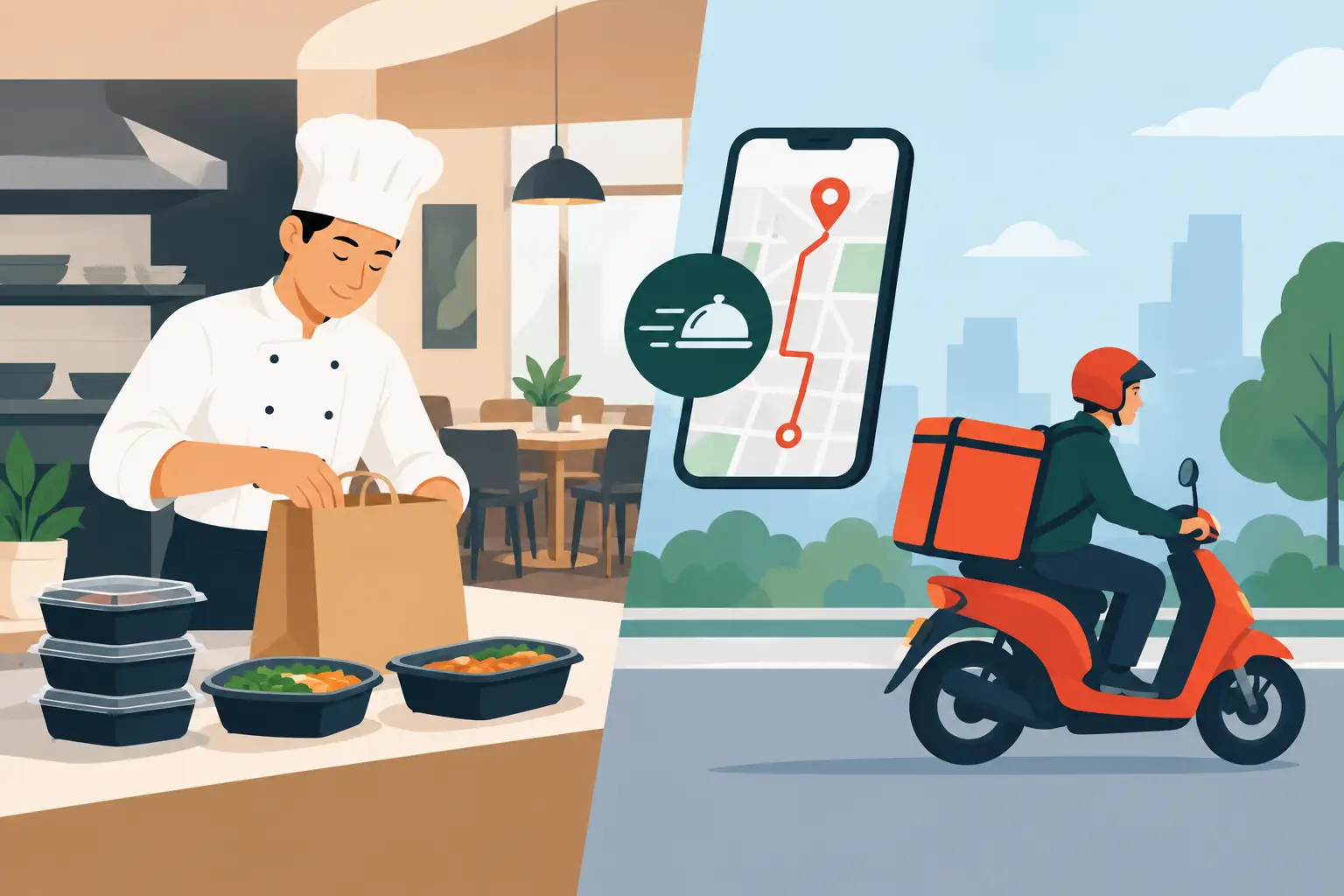
A dining room can be full and still leave money on the table. Equally, an empty dining room does not automatically mean delivery will fix the business. The question of when should restaurants add delivery is not about following a market trend. It is a commercial decision that should be made only when demand, kitchen capacity, menu economics, and execution controls can support it.
For UAE restaurant operators, delivery can create a valuable second revenue channel, extend trading hours, and turn underused kitchen capacity into new sales. But it also introduces aggregator commissions, packaging costs, longer production windows, customer-rating exposure, and an operating model that is very different from serving guests across a counter. A rushed launch often produces discount-led sales and weak ratings rather than sustainable growth.
A restaurant should consider delivery when it has a clear reason to believe that incremental orders can be produced profitably without weakening the core business. That requires more than a popular cuisine or a competitor presence on an app. It requires a decision-ready view of the local catchment, the expected order mix, and the operational cost of serving it.
The strongest case usually appears in one of three situations. First, the restaurant has unused kitchen capacity during off-peak periods and can add delivery orders without slowing dine-in service. Second, it serves a cuisine with proven delivery demand in its local area, but has limited physical visibility or seating. Third, the business has identified a delivery-only concept that can use the same equipment, ingredients, and labor as its existing operation.
Each situation has a different risk profile. An established dine-in restaurant may have production capacity but a menu built for immediate table service. A new cloud kitchen may have delivery-friendly food but no platform history, customer reviews, or reliable forecast. The commercial logic must account for the starting point.
Broad delivery demand is not enough. The real question is whether customers within a practical delivery radius will order this cuisine, at this price point, from this brand. A restaurant can be successful in a mall, hotel, or high-footfall district and still struggle online if its audience searches for different meals, values faster delivery, or expects a lower average check.
Assess the market at the meal-occasion level. A premium grilled concept may perform well for dinner but face limited lunchtime demand. A breakfast menu may be strong in residential communities but not in office clusters. Late-night items can generate meaningful volume, yet they may require separate staffing, security, and quality-control plans.
Platform research should also go beyond counting competitors. Review their delivery times, ratings, pricing, menu size, bundles, photos, and promotional activity. If the first page is dominated by well-rated operators offering aggressive discounts, a new entrant needs a credible reason to win orders. That reason may be better product quality, a more focused menu, a differentiated brand position, or a delivery window that competitors do not serve well.
Demand validation is particularly important before signing a new lease or building a dedicated production unit. A controlled launch from an existing licensed kitchen can often test the concept with less capital exposure than a full restaurant opening.
Delivery platforms can generate orders quickly, especially during promotions. The operational challenge is whether the kitchen can absorb those orders at the moments that matter most. If delivery tickets arrive during a restaurant’s busiest dine-in service, the result can be slower tables, delayed riders, incorrect orders, and declining ratings across both channels.
Capacity should be measured in production reality, not by how many staff members are on the roster. Map the full order flow: ticket acceptance, prep, cooking, assembly, packaging, handoff, and rider collection. Find the bottleneck. In some kitchens it is a grill; in others, it is the expediting counter, packaging station, or a single team member managing several marketplace tablets.
A restaurant is ready to add delivery when it can define a protected workflow for it. This may mean a separate packing station, designated peak-hour roles, clear item-holding times, and a controlled order-throttling process. It can also mean limiting the delivery menu at launch so the team can maintain speed and consistency.
The goal is not to accept every order. The goal is to accept the orders that can be fulfilled on time and to standard. On marketplaces, late preparation and cancellations can reduce visibility just as quickly as poor customer reviews.
A dish that earns praise in the restaurant may disappoint after 25 minutes in a rider bag. Crisp textures soften, sauces separate, hot foods lose heat, cold foods warm up, and carefully plated dishes arrive looking ordinary. Delivery adds time, motion, and packaging to the product experience.
Before launching, test the menu under actual delivery conditions. Prepare orders at realistic peak periods, package them as customers will receive them, and assess them after the expected travel time. Test flavor, temperature, presentation, portion integrity, and ease of eating. This process often reveals that a smaller, delivery-engineered menu will outperform a complete dine-in menu.
Packaging is part of the product, not an administrative cost. The right packaging protects quality, supports portion control, prevents leakage, and presents the brand properly. The wrong packaging can erase the benefit of a well-designed dish while increasing refunds and low ratings.
Menu engineering should also account for operational complexity. High-margin items are attractive, but not if they require too many assembly steps during peak service. The best delivery menus balance demand, food cost, preparation time, packaging requirements, and repeat-order potential.
Delivery revenue is not the same as delivery profit. Restaurants should model each major menu category after food cost, packaging, delivery-platform commissions, promotional funding, payment charges where applicable, labor, wastage, and any incremental management cost. If the channel only works when discounts are permanently high, it is not ready for scale.
Pricing needs a disciplined approach. Simply applying a flat markup to every item can make the menu uncompetitive, while keeping dine-in pricing unchanged can leave no contribution after commissions. Build pricing around target contribution, local competitive position, and customer value perception. Bundles, add-ons, and thoughtfully structured minimum baskets can improve average order value without relying solely on blanket discounts.
Owners should also separate launch costs from recurring operating costs. Product photography, menu setup, packaging trials, onboarding effort, and additional equipment may be one-time expenses. Extra labor, platform promotions, and replacement packaging are recurring. Mixing the two creates unrealistic expectations about payback.
A useful threshold is simple: delivery should add profitable contribution after the additional cost of serving it, not merely generate top-line sales. A busy kitchen that loses money on every delivery order is becoming less valuable, not more.
Adding delivery is not complete when the restaurant appears on an app. Marketplace performance depends on consistent availability, accurate menus, accepted orders, preparation times, customer ratings, conversion, and repeat purchase behavior. Poor setup can bury a capable concept beneath better-managed competitors.
Before going live, establish clear ownership for platform operations. Someone must manage item availability, stock-outs, order acceptance, customer issues, promotions, operating hours, and performance reporting. This responsibility cannot be treated as an occasional side task during service.
The launch should also have controlled improvement cycles. Review daily performance during the first weeks: impressions, menu views, conversion rate, average order value, cancellation reasons, prep-time accuracy, ratings, refunds, and top-selling items. These signals show whether the issue is visibility, menu appeal, price, kitchen execution, or customer expectation.
FoodWork often sees that rating recovery and revenue growth are linked to basic operational discipline: tighter preparation times, clearer menu descriptions, better packaging, and faster resolution of recurring issues. Marketing can increase exposure, but it cannot sustainably compensate for a weak order experience.
Not every restaurant needs to launch a full delivery operation at once. For an existing operator, a limited menu and defined delivery zone can be a sensible first test. It reduces strain on the kitchen while providing real data on demand and order behavior.
For a concept designed primarily for delivery, a cloud kitchen may offer greater flexibility than a traditional restaurant lease. It allows the business to prioritize production workflow, delivery access, and platform economics rather than paying for customer-facing space it does not need. The trade-off is that the brand must earn discovery and trust online without street visibility.
Established restaurants with idle capacity may also be ready to create a virtual brand. This works best when the new concept has a distinct customer occasion, can share ingredients and equipment intelligently, and does not confuse the core brand. It is not a shortcut for selling the same menu under another name. It needs its own positioning, menu logic, and operating controls.
The right time to add delivery is when the restaurant can test and operate it with discipline, not when pressure or excitement makes it feel urgent. Start with a defined commercial hypothesis, a menu that survives the journey, capacity that protects service, and a financial model that holds after commissions and promotions.
A controlled launch creates room to learn without damaging the main business. The operators that build lasting delivery revenue do not chase every order. They create an execution system that can earn the next one profitably.
Get clarity before you commit capital.

+971 52 288 5400
2101, Court Tower, Business Bay, Dubai UAE
hello@foodwork.ae
© 2026 FoodWork. All rights reserved
