
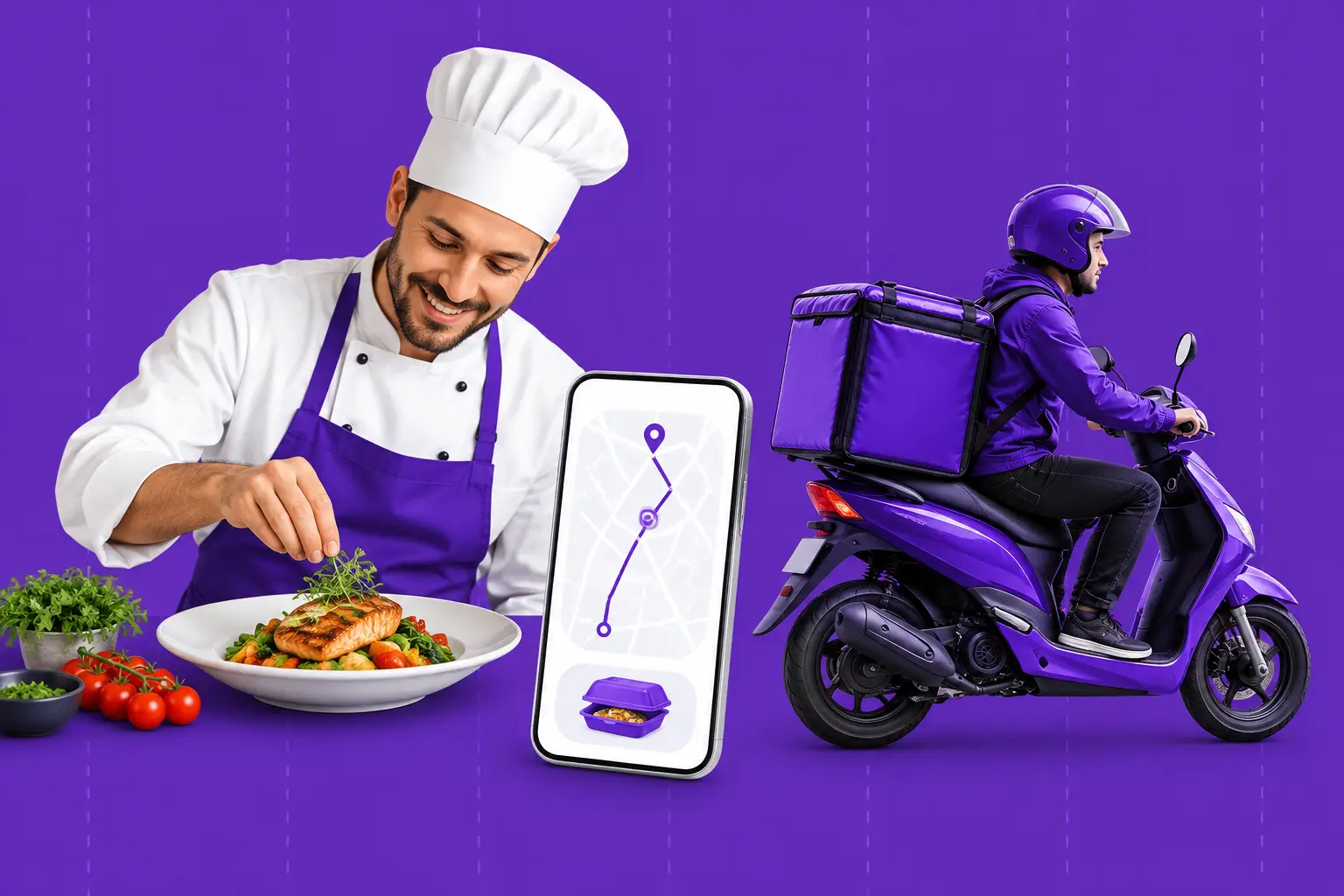
A restaurant can be busy on delivery platforms and still lose money on every order. The usual causes are not mysterious: a dine-in menu copied online, prep stations built for the wrong volume, prices that ignore commission and packaging, and no owner accountable for platform performance. Restaurant delivery transformation starts when delivery is treated as a separate operating model, not an additional sales channel.
For founders and operators, the goal is not simply to add more orders. It is to build a delivery business that can absorb demand, protect contribution margin, maintain ratings, and produce reliable data for the next decision. That requires coordinated work across commercial planning, kitchen execution, and marketplace management.
Delivery exposes weak economics quickly. A popular dish may look profitable when calculated against food cost alone, then become a loss once packaging, platform commission, discounts, payment fees, kitchen labor, remakes, and waste are included.
Before expanding delivery, establish a decision-ready model for each concept. It should show average order value, food cost by item, packaging cost, net sales after commissions and promotions, labor requirement, and expected contribution margin. This is not a one-time spreadsheet built for investors. It is an operating control that should be reviewed as prices, platform terms, and customer behavior change.
The key question is whether the concept can produce margin at realistic order volumes, not at its best possible month. A delivery business with low average order value often needs bundles, add-ons, or a revised menu architecture. A premium concept may need tighter delivery zones or packaging that protects quality over longer travel times. The correct answer depends on the product, the neighborhood, and the platform mix.
In Dubai and across the UAE, operators also need to factor in a competitive aggregator environment. Discounting can create short-term volume, but uncontrolled offers train customers to wait for promotions while reducing the cash available to fix operations. Promotions should have a defined purpose: acquiring first-time customers, supporting a weak daypart, introducing a new category, or recovering momentum after a platform issue. If the promotion cannot be measured against margin and repeat ordering, it is an expense rather than a growth tool.
A restaurant menu is designed around choice, service, and the experience at the table. A delivery menu must perform under search filters, limited screen space, variable courier travel times, and customer expectations shaped by photos, ratings, and price comparison.
That changes what should be listed and how it should be presented. The strongest delivery menus are not necessarily the longest. They make it easy for a customer to understand the core offer, choose a complete meal, and add high-margin items without friction. Category names, item descriptions, modifiers, image quality, and product availability all affect conversion.
Operationally, every item must pass a delivery test. Can the kitchen prepare it consistently during peak demand? Does it travel well for the expected distance? Will steam, sauces, or assembly time damage it before arrival? Does the packaging keep portions separate and identifiable? A dish that earns praise in the dining room may create refunds and low ratings after 25 minutes in transit.
Menu optimization also means controlling complexity. Excess modifiers, ingredients used by only one item, and too many low-volume products increase picking errors and slow production. Removing a weak item can improve the performance of the whole menu by reducing prep burden, stock risk, and customer confusion.
A lower displayed price can improve click-through, but it does not automatically improve profit. Price decisions need to account for each platform’s commercial terms, packaging, promotional contribution, and customer willingness to pay.
The practical approach is to set target net revenue by item, then test price points, bundles, and add-ons against conversion and margin. Do not assume every channel requires identical pricing if the economics differ. What matters is maintaining a clear commercial rationale, complying with platform requirements, and reviewing results regularly.
Many delivery operations fail at the point of success. Orders rise, ticket times stretch, product quality drops, couriers wait, and ratings decline. The issue is rarely effort. It is usually a workflow that was never designed for the actual order pattern.
A delivery-first kitchen needs clear movement from order acceptance to production, quality check, packing, handoff, and dispatch. Each handoff should have an owner. If the person cooking is also searching for packaging, checking tablet alerts, and managing courier questions, speed and accuracy will deteriorate when volume rises.
Capacity planning should be based on the busiest 30 to 60 minutes, not the daily average. Review how many orders each station can produce, where queues form, which ingredients require advance preparation, and what happens when multiple large orders arrive together. The findings may lead to a revised prep schedule, a dedicated expediting role, tighter delivery radius, or fewer items during certain dayparts.
Packaging deserves the same discipline. It protects food quality, but it also affects assembly time, cost, spill risk, and brand perception. Test it with real menu items after realistic travel times. A cheaper container that causes sogginess or leakage is expensive once refunds, replacements, and ratings are included.
Being listed is not the same as being visible. Marketplace performance is shaped by availability, acceptance rate, preparation time, delivery reliability, ratings, menu content, sponsored placement, promotional activity, and the platform’s own customer demand patterns.
This is why restaurant delivery transformation requires a recurring performance rhythm. Operators should review sales by platform and daypart, conversion where available, average order value, cancellation reasons, customer feedback, item-level availability, prep time, and rating trends. A falling rating is not a branding problem to discuss later. It is an operational signal that needs a root-cause review.
For example, poor feedback on food temperature may point to a packaging issue, an overly wide delivery area, delayed handoff, or a dish that should not be offered during a specific peak period. Complaints about missing items may require packing controls rather than retraining the cooking team. The response should match the source of the failure.
Rating recovery works best through controlled improvement cycles. Identify the recurring issue, assign a corrective action, monitor a small set of indicators, and confirm whether customer feedback changes. Avoid changing prices, menu items, packaging, staff schedules, and promotions all at once. When everything changes, it becomes difficult to know what improved performance.
Not every restaurant needs a new kitchen or a new brand. Established operators with underused capacity may be better served by creating a focused virtual brand that uses existing equipment, ingredients, and staff capability. The brand should be commercially distinct, but it must fit the kitchen’s real production capacity. A concept that needs new processes, new equipment, and unfamiliar ingredients can become a distraction rather than a revenue stream.
For a new cloud kitchen founder, the priority is usually controlled launch sequencing: feasibility, licensing, kitchen selection, vendor setup, staffing, platform onboarding, menu testing, and operating controls. Skipping steps may appear faster, but mistakes in the lease, kitchen layout, license scope, or menu model are costly to reverse after launch.
For multi-unit operators, transformation may focus on standardization. That means defining the delivery menu, packaging specification, prep-time targets, pricing rules, and platform reporting across sites while allowing for local demand differences. Consistency protects the brand, but rigid uniformity can be counterproductive if one location has a different customer profile or delivery radius.
Delivery performance sits between functions that are often managed separately: finance sets targets, chefs manage food, operations manages labor, marketing runs promotions, and someone monitors the apps when time allows. That fragmented structure creates gaps precisely where delivery businesses need speed and accountability.
A stronger model gives one operating team visibility across launch decisions and ongoing performance. It connects the financial blueprint to the menu, the menu to kitchen workflow, workflow to platform metrics, and platform results to the next commercial action. FoodWork applies this execution model for operators that need one coordinated partner rather than separate advice from multiple suppliers.
The practical test is simple: when sales fall, ratings decline, or margin tightens, can the business identify the cause and act within days? If the answer is no, the issue is not a lack of data. It is a lack of ownership and operating discipline.
The most valuable change is often not a new app listing or a larger menu. It is creating a repeatable way to make decisions, test improvements, and protect the customer experience when order volume increases.

Get clarity before you commit capital.

+971 52 288 5400
2101, Court Tower, Business Bay, Dubai UAE
hello@foodwork.ae
© 2026 FoodWork. All rights reserved
