
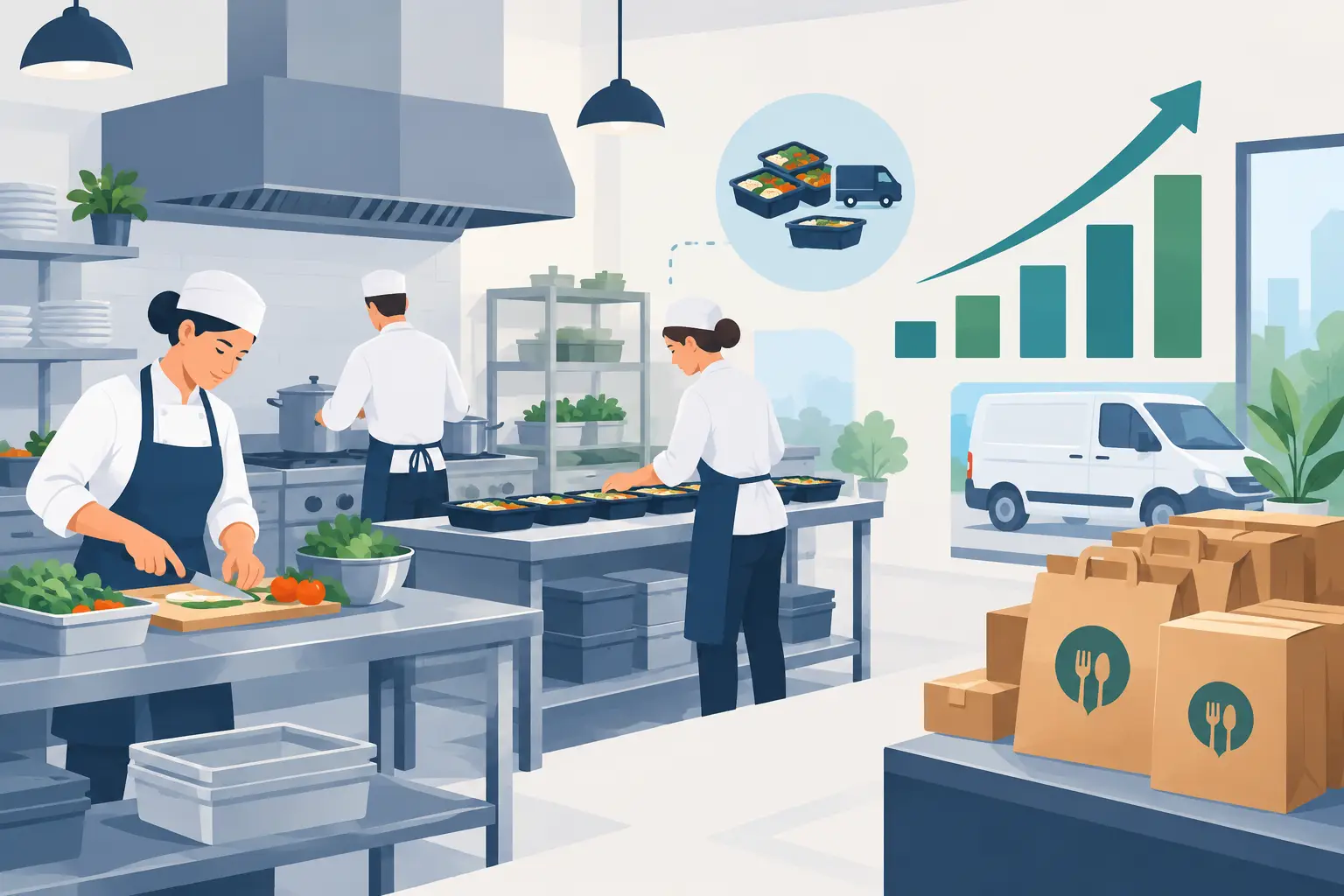
A delivery kitchen can look quiet at 4:00 p.m. and become operationally overloaded by 7:30 p.m. That gap is where margins disappear: orders queue at the pass, riders wait, food quality drops, staff rush, and marketplace ratings absorb the damage. Kitchen capacity planning gives cloud kitchen founders and restaurant operators a disciplined way to determine what their operation can produce, when it can produce it, and what must change before demand exceeds control.
For UAE delivery businesses, capacity is not simply the number of orders a kitchen completes in a day. It is the number of orders completed within promised preparation times, at the expected food quality, with labor and packaging costs still aligned to the financial model. A kitchen that processes 250 daily orders but regularly delays peak-hour tickets is not operating at 250-order capacity. Its usable capacity is lower.
Founders often plan capacity from a property or equipment perspective: how many stations fit in the unit, how many burners are available, or how many cooks can be scheduled. These inputs matter, but they do not answer the commercial question. The relevant question is whether the kitchen can fulfill the forecasted order mix at peak demand without compromising marketplace performance or contribution margin.
This distinction is especially important for delivery-first brands. Aggregator demand is concentrated around meal occasions, while order flow can change quickly through campaigns, weather, holidays, payday periods, and visibility improvements. A kitchen designed around average daily volume may fail during the two hours that determine its rating, cancellation rate, customer experience, and revenue.
Capacity planning should therefore sit beside feasibility, menu engineering, staffing, and aggregator onboarding. It informs the number of brands a site can support, which menu items should be promoted, whether a virtual brand is viable, and when an operator should invest in additional equipment or labor. It also prevents the opposite mistake: paying for a large kitchen, oversized team, or excess equipment before the demand case is proven.
Every kitchen has a limiting point. It may be fryer basket space, grill surface, cold assembly, one combi oven, packaging, expediting, or a single person handling platform tablets and rider handovers. Adding another cook does not solve a bottleneck caused by a congested fryer. Adding a second fryer does not solve delays created at the packing bench.
The first step is to map the order journey from ticket acceptance to handoff. Record each production stage, the average active time required, the equipment used, the staff role responsible, and any waiting time between stages. Do this by major menu category rather than relying on a single average ticket time. A burger, a fried chicken meal, a salad bowl, and a family bundle place very different demands on the same kitchen.
For a delivery operation, assess four connected constraints:
The slowest of these determines the usable output. This is why a kitchen can have enough cooking equipment yet still miss delivery times. If packaging, quality checks, or handoff procedures lag, finished food accumulates and the customer still experiences a late order.
Daily sales are useful for financial forecasting, but peak intervals drive operational design. Review order data in 15-minute or 30-minute blocks and identify the busiest periods by day of week. A brand with 120 orders per day may receive 35 of those orders in one lunch window. That 35-order interval, not the daily total, should guide staffing and station setup.
Use actual platform data where available. For a new launch, build conservative peak assumptions from the target cuisine, location, price point, delivery radius, and intended promotional activity. Then stress-test the plan. Ask what happens if a campaign doubles order intake for 45 minutes, a rider shortage extends handoff time, or the top-selling item represents 45% of tickets instead of the expected 25%.
A practical working calculation is:
Usable peak capacity = the lowest station output per interval, adjusted for labor availability, quality checks, and a buffer for variability.
The buffer matters. Planning to run every station at 100% utilization leaves no room for rework, large baskets, staff breaks, equipment recovery time, or a sudden surge. In most delivery kitchens, controlled output at 75% to 85% of theoretical capacity is healthier than chasing maximum throughput and losing service consistency.
Menu design and capacity are inseparable. A broad menu can create more customer choice while introducing too many prep methods, ingredients, packaging formats, and final assembly steps. During a peak period, that complexity becomes expensive.
Start by categorizing items according to their production path. Identify which products use shared equipment, which require made-to-order finishing, and which can be batch-prepped without reducing quality. Then examine contribution margin and sales mix. A high-volume item with a slow production path deserves more attention than a low-selling specialty item, even if both have similar food cost.
This analysis may lead to operationally useful decisions: limiting modifiers that slow assembly, moving a garnish step to prep, using one sauce across multiple products, changing a side dish, or separating a high-demand product into a dedicated station. The right answer depends on brand positioning. A premium concept may choose a slower process to protect product quality, but that choice should be priced and staffed deliberately.
Virtual brands require the same discipline. Unused kitchen capacity is only valuable when the existing team, equipment, storage, and dispatch process can absorb another menu without disrupting the core restaurant. A virtual brand that competes for the same fryer, prep table, or packing area during peak hours can reduce total revenue even when it adds sales on paper.
Once the production flow is clear, translate it into a staffing model by service window. Do not schedule only by total headcount. Define who owns each critical station, who takes over during breaks, and who has authority to pause promotions, adjust prep times, or temporarily restrict an unavailable item.
A basic peak shift may need a hot-line cook, cold or assembly cook, expediter, packer, and shift lead. In a smaller operation, one person may cover multiple roles during quiet periods. At peak, however, combining too many responsibilities creates avoidable errors. The person accepting orders should not also be trying to resolve rider disputes while checking food quality on a growing queue.
Pre-shift preparation is part of capacity. Portioning, sauces, mise en place, packaging stock, labels, printer checks, and equipment warm-up all determine whether the line can meet the first surge. Track shortages and repeated rework in the same way you track sales. If a station runs out of prepped ingredients twice a week, its planned capacity is overstated.
Delivery platforms provide an immediate view of operational strain. Rising preparation times, late orders, customer complaints about temperature, cancellations, unavailable items, and rating declines should be treated as capacity signals, not isolated incidents.
Set operating thresholds before a problem becomes public. For example, define the maximum active order queue per station, the acceptable preparation-time range, the minimum packaging stock level, and the point at which a campaign should be paused. These controls allow the team to protect the brand during an unexpected surge rather than accepting every order and failing customers later.
Controlled improvement cycles are more effective than large, untested changes. Adjust one variable, such as prep quantity, station layout, staffing overlap, or a menu item’s finish time. Measure the result over comparable service periods, then decide whether to standardize the change. FoodWork applies this execution-led approach because capacity becomes reliable through operating data, not assumptions made at launch.
Additional equipment or labor is justified when the constraint is repeatable, measurable, and tied to profitable demand. If the same station limits output across several high-demand periods, and the lost orders or service failures exceed the cost of fixing it, investment is likely warranted.
But not every issue needs more square footage. Sometimes the better answer is simplifying a menu, resetting delivery zones, changing prep schedules, reallocating staff, improving packaging flow, or using demand controls during the busiest window. Capacity expansion should follow evidence, not frustration.
A well-planned kitchen does not aim to be busy at all costs. It aims to produce profitable orders with predictable speed and consistent quality. Review peak-hour performance weekly, protect the stations that constrain output, and let the data tell you when growth is operationally ready.

Get clarity before you commit capital.

+971 52 288 5400
2101, Court Tower, Business Bay, Dubai UAE
hello@foodwork.ae
© 2026 FoodWork. All rights reserved
