
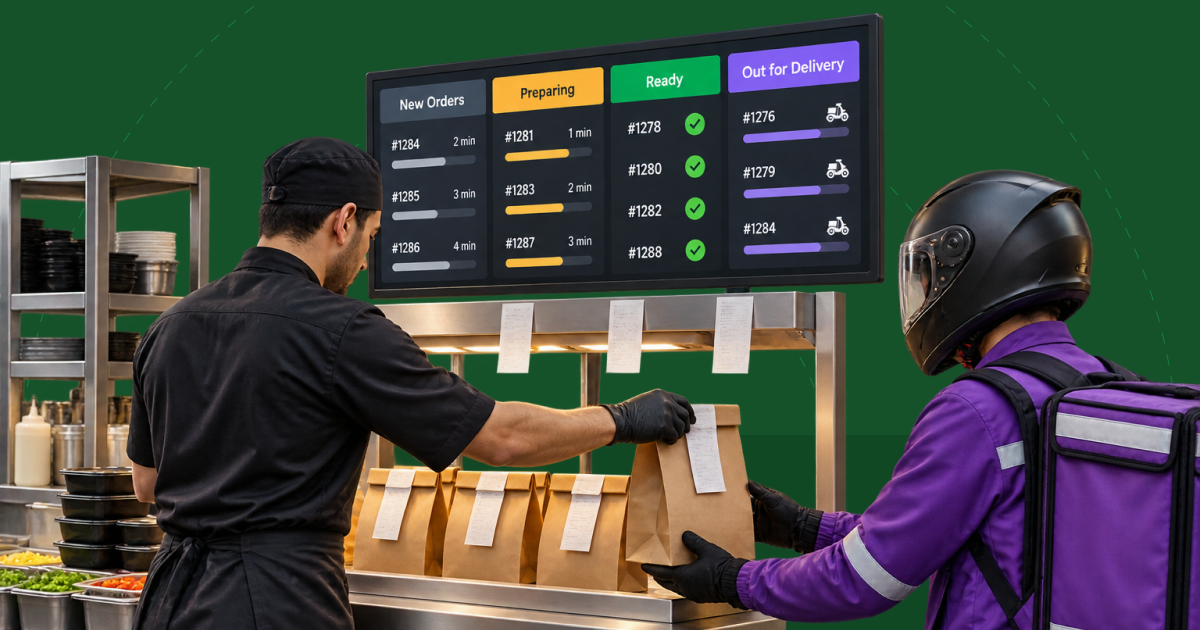
How to streamline kitchen dispatch starts by treating handover as its own station with its own owner. Most late orders in UAE cloud kitchens are not cooked late, they are packed late, staged badly or handed to a rider who was never told the order was ready.
A delivery order can be fully prepared and still fail commercially in the final three minutes. Food sits on a counter, a rider waits at the wrong entrance, a drink is added late, or a packed bag is not marked ready on the platform. Learning how to streamline kitchen dispatch means controlling this final handoff as tightly as food production, because it affects customer ratings, rider wait time, refund risk, and repeat-order performance.
For cloud kitchens and delivery-focused restaurant brands, dispatch is not a side task assigned to whoever is free. It is a defined operating function between the pass and the rider. The objective is simple: every order should leave complete, correctly packed, temperature-protected, and matched to the right driver at the right time.
Most dispatch problems are presented as staffing problems. Sometimes that is true, especially during a peak period where order volume exceeds the physical capacity of the packing and pickup area. More often, however, the issue is unclear movement: finished orders enter one space, packaging is stored elsewhere, riders crowd the production line, and no one owns the final readiness check.
Map the order journey from the moment a ticket prints or appears on the kitchen display system to the moment the rider departs. Record who accepts the order, where it is prepared, where it is packed, where it waits, how the rider is identified, and who confirms collection. This exercise exposes wasted movement and hidden queues quickly.
A practical dispatch zone needs a clear boundary from production. Riders should not enter the hot line or interrupt cooks to ask whether an order is ready. The zone should have organized packaging, tamper seals, order labels, beverages, condiments, insulated holding where appropriate, and a visible pickup shelf or numbered collection point.
The layout depends on the format. A high-volume cloud kitchen may need separate packing, quality-control, and rider-handoff positions. A smaller restaurant launching a virtual brand from unused capacity may combine these roles during quiet hours. The non-negotiable point is ownership: one person must know the status of every order that is ready, delayed, missing an item, or waiting for collection.
Dispatch becomes unreliable when the kitchen display screen, aggregator tablet, printed ticket, and packed bag all tell slightly different stories. Staff then spend time asking questions instead of moving orders.
Set a standard order-status sequence and use it consistently across platforms and shifts. The exact labels can vary, but the operational flow should be clear: accepted, in production, quality checked, packed, ready for pickup, and collected. The person responsible for changing each status must be defined.
For example, cooks should not mark an order ready just because the main item has left the grill. An order is ready only when every component has been checked, packed, sealed, labeled, and placed in the designated pickup position. This prevents the common problem of a rider arriving for an order that is technically ready on the app but physically incomplete.
Where multiple aggregator tablets are still in use, appoint a single order controller during peak periods. Their role is to monitor incoming orders, preparation promises, rider arrival signals, and exceptions. This reduces missed tickets and avoids conflicting decisions when delivery platforms adjust expected pickup times.
A controlled dispatch process uses distinct responsibilities, even if one team member performs more than one role in a low-volume shift. During peaks, roles should be visible and fixed rather than improvised.
The expediter coordinates the pass, checks that production is progressing against promised time, and calls out orders that need attention. The packer verifies items, portions, add-ons, labeling, and bag integrity. The dispatcher manages the ready shelf, confirms rider identity, hands over the correct bag, and updates collection status.
This separation matters because each role catches a different failure. A cook focuses on food quality and speed. A packer catches missing sauces, incorrect modifiers, and packaging issues. A dispatcher prevents the wrong rider from taking the wrong order or a completed bag sitting too long without action.
In a compact operation, the shift lead can combine expediter and dispatcher duties. But do not ask a line cook to leave a busy station repeatedly to manage riders. The short-term labor saving usually creates longer ticket times, poor communication, and avoidable order errors.
The fastest dispatch process is not always the best one. Preparing every item too early can reduce rider wait time but damage fries, fried items, cold desserts, or hot beverages before collection. Holding food for too long protects neither quality nor margin.
Use menu-level timing rules. Items with short quality windows should be fired closer to rider arrival or final assembly. Components that hold well can be prepared earlier. This requires a menu that has been designed for delivery, not simply transferred from a dine-in operation.
Track the gap between “ready for pickup” and “collected.” If the average gap is high, first establish whether the cause is kitchen readiness, rider allocation, building access, or an unrealistic preparation time configured on the platform. The corrective action depends on the cause. Increasing prep time may reduce rider waiting, but it can also weaken conversion if the displayed customer delivery time becomes uncompetitive.
A sensible operating target varies by cuisine, platform, location, and peak demand. Rather than relying on a universal benchmark, establish a baseline for each brand, then run controlled improvement cycles. Measure changes by daypart and platform, not only as a weekly average. Friday dinner behavior may require a different dispatch model than weekday lunch.
Packing is the final opportunity to protect the order before it leaves the kitchen. Treat it as a quality-control gate, not an administrative step.
The packer should match the ticket to the physical items, check modifiers and add-ons, separate hot and cold products where needed, secure liquids, include required cutlery or condiments, and apply a tamper-evident seal. Labels should show the order number clearly enough for the dispatcher and rider to verify without opening the bag.
Avoid adding excessive inserts, loose marketing materials, or unnecessary packaging that slows the line and creates clutter. Include only what supports the customer experience or is required for the item. Packaging costs are part of delivery unit economics, so the right standard balances presentation, product protection, speed, and cost.
For brands with recurring missing-item complaints, introduce a short pack-check system for the most frequently missed components. This should be specific to the menu. A generic reminder to “check everything” is weaker than a clear confirmation for drinks, dips, sides, or paid add-ons.
The rider handoff should take seconds, not minutes. Create a visible pickup protocol that works even when several delivery platforms have riders arriving at once. Riders need to know where to wait, how to identify an order, and who can answer an exception without disrupting production.
Verify the rider against the order number or platform confirmation before releasing the bag. Do not rely on a verbal brand name, particularly in shared cloud-kitchen facilities where multiple concepts may have similar orders. Once the order is handed over, update it as collected immediately. A delayed status update can distort platform data and make a completed handoff appear as a kitchen delay.
Exception handling needs its own rule. If an item is missing, an order is damaged, or the assigned rider has changed, the dispatcher should know who approves the solution and how it is recorded. Quick fixes without documentation become repeated failures because the underlying pattern remains invisible.
Dispatch performance should be reviewed as part of platform and kitchen performance, not only when complaints increase. Focus on a small set of measures that link operations to commercial outcomes: average ticket time, ready-to-collected time, rider wait time, order accuracy, remake rate, cancellation rate, and rating feedback tied to food temperature or missing items.
Review these measures alongside daypart, platform, menu item, and staffing data. If cancellations rise only during a certain hour, the answer may be production capacity. If missing-item complaints center on one bundle, the issue is likely packing design. If riders wait while completed orders sit on the shelf, the problem may be status discipline or pickup-zone management.
FoodWork approaches dispatch as part of revenue-focused execution, because a better handoff does more than reduce kitchen friction. It protects ratings, strengthens marketplace reliability, and gives a delivery brand more control over the customer experience after the food leaves the pass.
The practical test is straightforward: walk the dispatch journey during your busiest 30 minutes and watch where orders stop moving. The next improvement should remove that specific delay, assign it to an owner, and be measured in the following shift. That is how dispatch becomes controlled rather than reactive.
Dispatch needs three zones within arm’s reach: a staging shelf for completed items, a packing bench with packaging pre-folded and labels ready, and a rider handover point that no one has to walk into the kitchen to reach.
Give the station a single owner during peak. When packing is shared by whoever is free, orders sit on the pass while riders wait outside, preparation time inflates and the platform records the delay against your listing. A dedicated packer at peak usually pays for itself in rating protection alone.
Sequence by promise time, not by ticket order. Print or display the required dispatch time on every ticket so the kitchen cooks to a clock rather than to arrival order, and batch items that share equipment without letting a batch delay an order already past its window.
Platform partner guidance from Talabat and other aggregators is explicit that accurate preparation times and low rejection rates support visibility, so dispatch discipline is both an operations and a marketing decision.
It depends on menu complexity, but the number must be honest. A listing that promises ten minutes and delivers twenty accumulates late orders and rating damage. Set preparation time from real ticket data per daypart and revise it monthly.
Yes. A single owner for packing and handover prevents the pass from becoming a queue, keeps rider waiting time down and gives you one person accountable for the accuracy of what leaves the kitchen.
Use a printed checklist on the packing bench, seal bags only after a verbal confirmation against the ticket, and photograph high-value or complex orders during the first weeks. Missing items are the single most common cause of one-star reviews.
It does. Leaks, collapsed lids and food that arrives cold generate low scores even when the cooking was correct. Test packaging on a 30-minute journey before committing to a supplier.
Late dispatch, rejected orders and long preparation times are signals platforms measure directly. Poor dispatch performance reduces impressions, which reduces orders, which makes the next promotion more expensive.
Orders breaching promise time, average preparation time by daypart, rejection and cancellation reasons, rider waiting complaints and any items repeatedly marked unavailable.
Our managed operations team builds these routines inside client kitchens, and the delivery rating recovery calculator shows what dispatch problems have already cost your rating.

Get clarity before you commit capital.

+971 52 288 5400
2101, Court Tower, Business Bay, Dubai UAE
hello@foodwork.ae
© 2026 FoodWork. All rights reserved
