
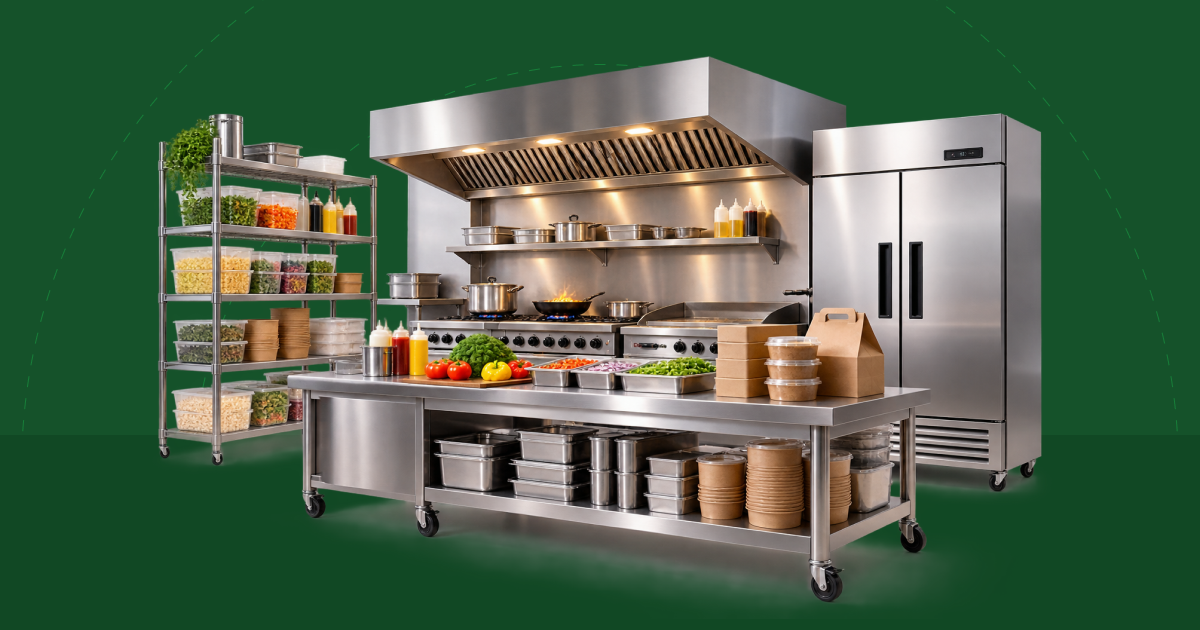
A delivery kitchen can lose money long before its first poor review. The cause is often not the recipe or the demand. It is cloud kitchen equipment selected without a clear service model, production forecast, or delivery-time standard. An oversized fryer consumes capital and power. An undersized refrigeration plan creates prep bottlenecks. A poorly positioned packing station can turn a 20-minute ticket into a late order during peak demand.
For UAE founders and restaurant operators, equipment decisions should follow commercial validation, not personal preference or a supplier’s standard package. The right setup protects food quality, ticket times, labor productivity, compliance, and the unit economics required to grow.
There is no universal equipment list for a cloud kitchen. A burger concept, a premium Asian bowl brand, and a bakery-led virtual brand may operate from similar floor areas, but their production requirements are materially different. Equipment must support the menu, expected order mix, peak-hour volume, prep strategy, and dispatch promise.
Before sourcing begins, define how the kitchen will make money. Estimate average order value, target food cost, planned delivery radius, projected orders by daypart, and the mix of single-item versus bundled orders. Then translate that model into production demand. A concept expecting 12 orders per hour has different needs from one planning for 45 orders in a concentrated dinner window.
This is where many launches lose control. They buy for an optimistic opening month rather than a defensible demand scenario, or they install equipment based on a dine-in kitchen template. Delivery-first operations require less front-of-house infrastructure but greater discipline around batch prep, holding time, packing, and pickup flow.
A practical equipment plan should answer four questions:
The objective is not to buy the most equipment. It is to create enough capacity to execute the launch plan consistently, then expand from measured demand.
A menu is an operational specification. Every item determines a sequence of storage, prep, cooking, finishing, packing, and dispatch. If a menu has too many cooking methods, temperature-sensitive components, or made-to-order garnishes, the equipment requirement and labor complexity increase quickly.
Start by mapping each menu item through the kitchen. Identify shared ingredients, common cooking processes, and points where orders can queue. A strong delivery menu often uses a limited number of primary production methods. For example, a grilled protein bowl concept may need refrigerated prep tables, a grill, a combi oven or holding solution, a rice-cooking process, cold assembly space, and a dedicated packing bench. It does not necessarily need every appliance found in a full-service restaurant.
The trade-off is menu flexibility. A broad menu can increase customer appeal, but it can also create lower utilization across too many stations, more inventory, slower training, and inconsistent delivery quality. For a new brand, a tighter menu supported by high-use equipment is usually easier to control.
Packing is not an afterthought in delivery. It is the final quality-control station, and it needs enough counter space, storage for packaging, printer access, order screens, tamper seals, and clear rider handoff procedures. If packers share space with cooks, completed food is more likely to be delayed, mislabeled, or exposed to avoidable handling.
Plan for hot and cold components, sauces, cutlery, and order checks at the packing point. The right layout reduces movement and makes exceptions visible before an order leaves the kitchen. This protects ratings as much as it protects speed.
Most delivery-first kitchens rely on the same broad categories, but the required capacity and specification depend on the concept. Cooking equipment may include ranges, fryers, griddles, ovens, combi ovens, grills, steamers, and specialty units. Refrigeration covers upright fridges and freezers, undercounter units, cold prep counters, walk-in storage where justified, and blast chilling for concepts with suitable batch-production processes.
Preparation equipment includes stainless worktables, sinks, mixers, food processors, slicers, scales, and storage systems. Warewashing requires an appropriate dishwasher or glasswasher where relevant, plus enough sinks and drainage to meet the approved layout. Finally, extraction, ventilation, fire suppression, grease management, and make-up air are not secondary infrastructure. They affect what equipment can be installed and whether the kitchen can operate safely and compliantly.
In the UAE, sourcing must be coordinated with the site’s approved drawings, building constraints, power load, gas availability, landlord requirements, and local authority requirements. A kitchen can be commercially promising and still become expensive if ventilation, drainage, or electrical upgrades are discovered after equipment has been ordered.
Average daily orders are a weak basis for equipment planning. The pressure point is the peak period, especially dinner and weekend demand when marketplace visibility can create sudden order spikes. Capacity should be assessed station by station: how many portions per hour can the grill, fryer, oven, prep counter, and packing line reliably produce with the planned team?
A useful approach is to calculate the time needed per item at each critical station, then test the workflow against a realistic peak-order scenario. If a fryer can produce the required volume but the packing bench can only finish half the orders, the kitchen still has a bottleneck. If cold storage cannot hold enough mise en place for a full operating day, staff will spend peak hours restocking instead of producing.
Do not solve every bottleneck by buying larger equipment. Sometimes the better answer is a menu change, earlier prep cycle, revised batch size, improved station placement, or an additional team member at the point of constraint. Equipment is only one part of the operating system.
The lowest purchase price is rarely the lowest operating cost. High-use equipment should be assessed for recovery time, temperature consistency, cleaning requirements, spare-parts availability, warranty terms, energy use, and local service support. A unit that fails during a Friday evening peak can cost far more than the difference between two supplier quotes.
This does not mean every item should be premium. Lower-risk assets such as shelving, some worktables, or secondary storage can often be sourced more economically if they meet food-safety and durability requirements. Invest more carefully in the equipment that directly controls production speed, product consistency, and food safety.
A kitchen layout that looks efficient on paper can fail if staff cannot clean behind equipment, access drains, move stock safely, or complete opening and closing routines without congestion. Allow working clearances, logical waste flow, accessible storage, and designated cleaning tools. These details influence hygiene standards, labor hours, and the kitchen’s ability to sustain service over time.
Staffing should also inform the specification. Complex equipment can deliver excellent output, but only when operators are trained and procedures are followed. If the launch team is lean, choose processes that are repeatable under pressure. Standardize cooking times, holding limits, portioning tools, and temperature checks before the first marketplace order is accepted.
The equipment plan should be reviewed after launch against actual sales, ticket times, cancellation reasons, customer ratings, waste, and labor performance. A controlled improvement cycle reveals whether the next investment should be another fryer basket, more refrigerated prep capacity, a better sealing process, or a menu simplification.
For existing restaurants launching virtual brands, this review is even more important. Idle capacity can be valuable, but only if the new brand does not compromise the core business during its busiest periods. Measure available production capacity by daypart and protect the stations, storage, and staff hours that the dine-in operation already requires.
FoodWork approaches sourcing as part of a coordinated launch plan, linking menu requirements, approved layouts, vendor coordination, staffing, and delivery-platform readiness. That coordination matters because a kitchen is not ready when equipment arrives. It is ready when every station can produce, pack, dispatch, and recover from a busy service without losing commercial control.
The best equipment decision is the one that makes the next 100 orders easier to execute than the first 10. Build for the demand you can validate, leave room for measured expansion, and let operating data determine what the kitchen needs next.
Get clarity before you commit capital.

+971 52 288 5400
2101, Court Tower, Business Bay, Dubai UAE
hello@foodwork.ae
© 2026 FoodWork. All rights reserved
