
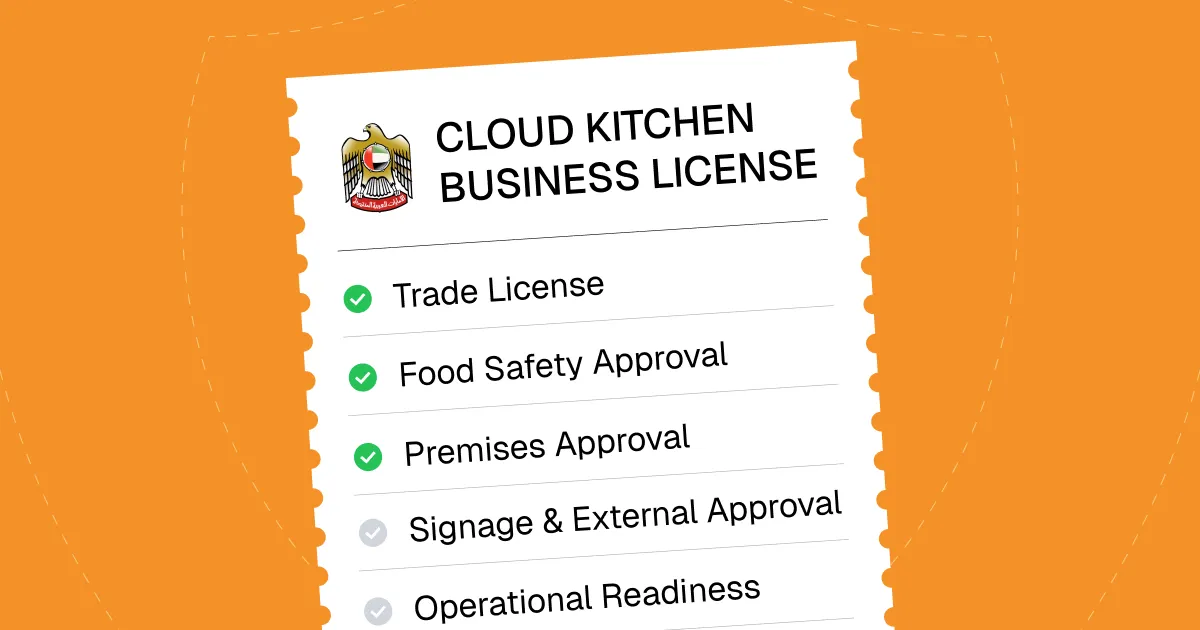
A delivery brand can have a strong concept, a capable chef, and a ready menu, then lose weeks because its restaurant licensing plan started after the kitchen decision. In the UAE, licensing is not a single form. It is a sequence of commercial, food-safety, premises, and operational approvals that must align with the way the business will actually trade.
For a delivery-first operator, that alignment matters from day one. The legal activity must support the business model. The kitchen must be approved for its intended production. The menu and workflow must meet food-safety requirements. Delivery platforms will also require complete, matching business documentation before a brand can go live. A gap at any point creates avoidable delays, extra cost, or a launch built on the wrong operating structure.
The first question is not, “Which license is fastest?” It is, “What business are we licensing?” A standalone restaurant, a cloud kitchen tenant, a managed kitchen operation, and a virtual brand running from an existing restaurant kitchen can require different approval paths and commercial decisions.
A founder taking a dedicated cloud kitchen unit needs to assess the facility’s existing approvals, permitted activities, landlord documentation, layout suitability, utility capacity, and fit-out obligations before signing. A lower rent is not a saving if the unit requires redesign, equipment changes, or further approvals to support the intended cuisine and production volume.
An operator using an existing kitchen has a different task. The kitchen may already be licensed, but that does not automatically mean every new delivery brand, food category, or production process can be added without review. The current license activity, approved kitchen capacity, menu scope, storage, labeling, and delivery workflow must be checked. This is especially relevant when a dine-in restaurant wants to monetize idle capacity with virtual brands.
The practical principle is simple: choose the operating model first, then build the licensing path around it. Reversing that order often leads to a license that looks correct on paper but creates operational limits after launch.
Restaurant licensing in the UAE typically combines several connected workstreams. The exact requirements vary by Emirate, jurisdiction, location, and business activity, but the operating logic remains consistent.
The business needs an appropriate legal structure, trade name, and commercial activity through the relevant economic authority or free-zone authority. Activity selection deserves more attention than it usually receives. It should reflect how revenue will be generated and who will operate the food business.
For example, the structure for a brand operating from its own kitchen may differ from a company providing management services, operating multiple concepts, or licensing a brand to another kitchen. Investors should also consider ownership, visa requirements, banking, contractual obligations, and future expansion before selecting a structure simply because it appears inexpensive or quick.
A food business must meet the requirements of the relevant local food-safety authority. This normally involves premises information, kitchen layout, equipment specifications, hygiene controls, storage arrangements, waste handling, pest control, and documentation for food handling procedures.
This stage is where delivery-first planning becomes visible. A kitchen designed for dine-in service may not have adequate packing space, dispatch flow, cold storage, or segregation for a high-volume delivery operation. The approval process can expose these issues, but it is more efficient to solve them during layout and workflow planning rather than after equipment has been installed.
Depending on the site and jurisdiction, additional approvals can apply to fit-out, civil defense, ventilation, gas systems, signage, or landlord requirements. Not every location has the same pathway. A fitted shared kitchen and a shell-and-core restaurant unit should not be treated as equivalent projects.
The key commercial risk is sequencing. Paying for a fit-out before confirming the necessary technical requirements can lead to rework. A controlled launch identifies the approval dependencies before construction, equipment procurement, and branding commitments become difficult to change.
Licensing is not complete simply because the trade license has been issued. Before trading, the operation needs the supporting controls that allow the kitchen to run safely and consistently. These may include staff documentation and training, supplier records, cleaning schedules, temperature controls, food labeling processes, and traceability procedures.
For delivery businesses, packaging standards and dispatch controls also matter. A compliant kitchen can still lose revenue if food quality drops during delivery, orders are delayed at handoff, or product labeling creates platform and customer-service issues.
The most expensive licensing mistake is committing to a site, fit-out, or kitchen contract without a decision-ready approval plan. Speed does not come from skipping steps. It comes from completing the right steps in the right order.
Start with a feasibility view that tests the concept against realistic delivery demand, menu economics, kitchen requirements, and target areas. This should establish whether the brand needs a dedicated site, a shared kitchen, or an existing licensed kitchen with unused capacity. It should also clarify the commercial activity and operating entity needed for the model.
Next, review the selected facility in operational terms. Confirm the kitchen can support the menu, production method, storage volumes, extraction needs, utility loads, and rider handoff process. A menu with fried items, grilled proteins, chilled desserts, and high-volume beverages has different equipment and workflow implications than a compact rice-bowl concept.
Then organize the documentation and authority submissions as one coordinated workstream. Commercial registration, tenancy or kitchen agreements, layout drawings, technical approvals, food-safety submissions, and staff planning should move in sequence rather than through disconnected vendors. Fragmentation is where launch timelines become unreliable.
Finally, plan platform onboarding in parallel with final readiness, not as an afterthought. Delivery platforms commonly need legal documents, banking details, menus, brand assets, pricing, tax information where applicable, and operational contacts. A business that receives its approvals but has not prepared these materials is still not ready to generate orders.
Cloud kitchens can reduce upfront capital and shorten the path to market, but they do not remove the need for disciplined licensing. The benefit is that some infrastructure and facility-level approvals may already be in place. The trade-off is reduced control over the site, shared services, operating rules, and sometimes expansion capacity.
Before selecting a cloud kitchen, confirm exactly what the operator provides and what remains the brand owner’s responsibility. This includes the permitted use of the kitchen, equipment availability, storage allocation, waste arrangements, cleaning responsibilities, staff access, delivery pickup rules, and documentation required for platform onboarding. Assumptions at this stage often become disputes after the first month of trading.
Virtual brands require similar care. If an established restaurant adds a delivery-only concept from its existing kitchen, the commercial case may be compelling because fixed costs are already absorbed. Yet the operator still needs to test whether the new menu can be produced without affecting the core business. Capacity, food safety, procurement, packaging, order throttling, and brand-specific platform setup all need defined ownership.
A virtual brand should not be treated as a logo added to an aggregator. It is a separate revenue line with its own menu performance, conversion rate, ratings, preparation time, and repeat-order potential. Licensing and operating readiness should support that level of control.
Most delays are predictable. They arise when the legal setup, physical kitchen, and commercial launch plan are managed separately.
One common issue is choosing a kitchen before validating the concept’s requirements. Another is using generic activity selections that do not reflect the intended model. Operators also lose time when drawings, equipment lists, and actual kitchen workflows do not match. Late platform onboarding is equally costly because it turns a completed kitchen into an idle fixed-cost base.
There is also a false economy in treating licensing as an administrative task handled independently from financial planning. Every delay extends rent, payroll, equipment finance, and working-capital exposure before revenue starts. The licensing timeline should therefore sit inside the launch budget and cash-flow model, with contingency for authority queries, revisions, and supplier lead times.
A well-managed restaurant licensing process does more than secure permission to trade. It forces clarity on the entity, site, kitchen capacity, menu, staffing, compliance controls, and revenue channels that will shape the business after opening.
For founders, the objective is not merely to obtain approvals quickly. It is to reach first orders with a kitchen that can produce consistently, a platform setup that is ready to convert demand, and a cost base that the forecast can support. FoodWork approaches licensing as part of that wider controlled launch process, connecting setup decisions to operating readiness and commercial performance.
Treat every approval as a decision gate: does this structure support the brand you intend to run, not just the documents you need to submit? That question protects both launch speed and the revenue you are building toward.
Get clarity before you commit capital.

+971 52 288 5400
2101, Court Tower, Business Bay, Dubai UAE
hello@foodwork.ae
© 2026 FoodWork. All rights reserved
