
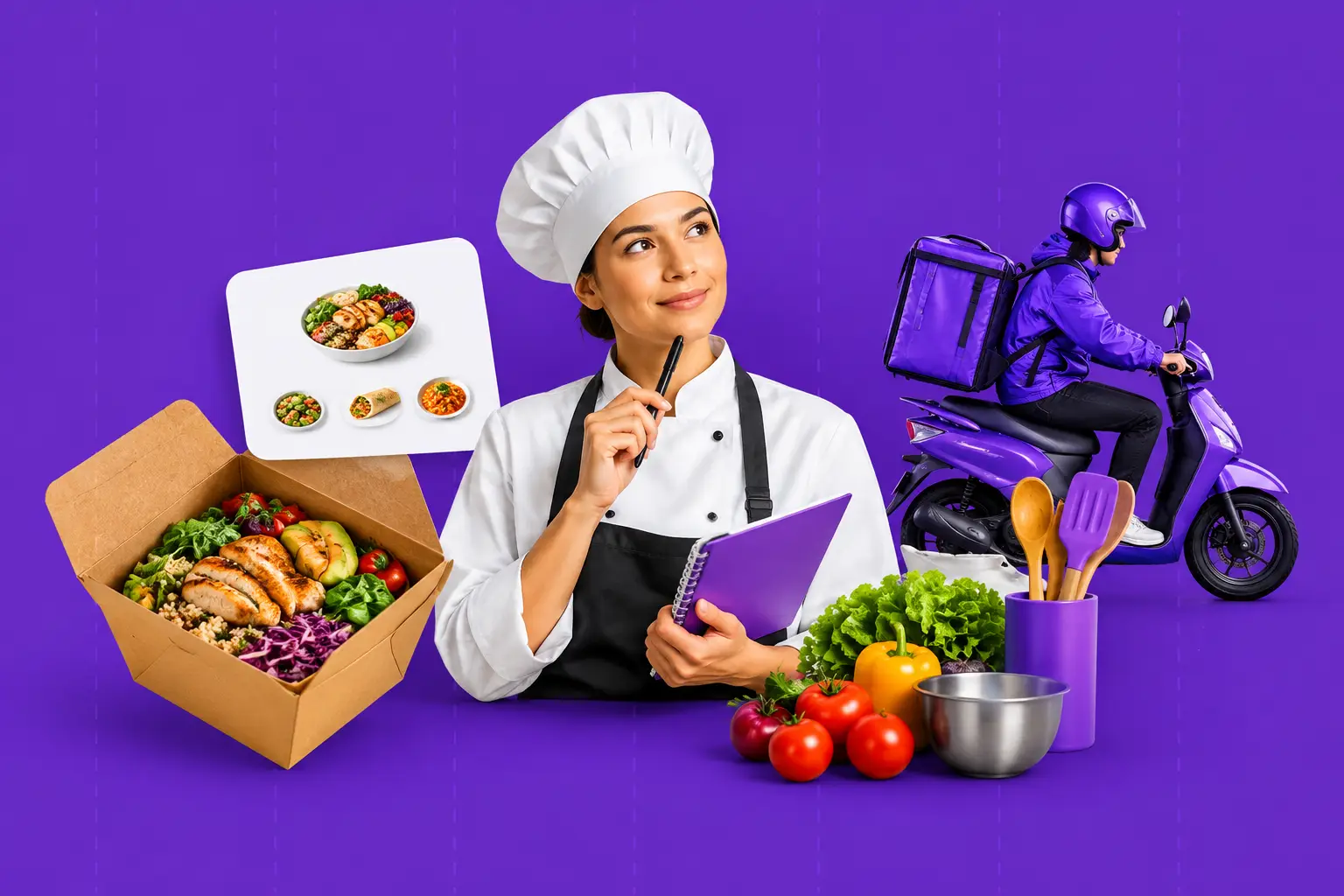
A concept can look strong on a mood board and still fail in a delivery bag. The real question is not whether people like the food. It is whether the food can be produced consistently, priced profitably, delivered well, and discovered repeatedly on crowded delivery platforms. That is how to choose a food concept with commercial discipline rather than personal preference.
For a delivery-first business, the concept is not just cuisine. It is the operating model behind the cuisine: the customer occasion, menu architecture, kitchen workflow, packaging, price position, delivery radius, and marketplace proposition. A decision that feels small at the concept stage can determine whether the business has controlled margins or constant operational friction after launch.
People do not order categories in the abstract. They order for a specific moment: a quick weekday lunch, a family dinner, a late-night craving, an office meal, or a familiar comfort-food choice after a long day. Your concept needs to own one or two high-frequency occasions before it tries to serve everyone.
A premium breakfast concept may have excellent products but limited order windows. A family meal concept may generate higher average order values but require menu bundles and reliable portion control. A late-night concept may face less direct competition in some zones, but it needs staffing, preparation discipline, and ingredients that remain available through extended operating hours.
Define the primary customer in practical terms. Where are they ordering from? When do they order? What problem are they solving? How much are they comfortable spending before delivery fees and platform promotions? These answers should shape the concept more than a founder’s favorite cuisine.
Demand in Dubai is not uniform. A concept that performs in a dense residential community may struggle in a business district, even when the menu and brand are identical. Delivery platforms reward local relevance, availability, conversion, and customer satisfaction. Broad market assumptions are not enough.
Review the proposed delivery zones before committing to a kitchen or menu. Look at the density of comparable listings, their ratings, review themes, menu prices, delivery times, promotional activity, and the number of brands competing for the same occasion. The goal is not to avoid competition entirely. Strong competition can signal proven demand. The question is whether there is space for a clearly differentiated offer.
Differentiation should be specific. “Better quality” is not a positioning strategy unless customers can see it in the menu, images, portion, speed, or price. A clearer proposition might be a focused menu built for office lunches, a high-value family bundle, restaurant-quality grilled meals that travel well, or a fast premium bowl concept with clear dietary choices.
Highly visual products can generate attention but still produce weak repeat orders. Delivery businesses are built on operationally reliable, repeatable demand. If the product is difficult to eat after transit, arrives inconsistently, or feels expensive for the portion, initial curiosity will not create sustainable revenue.
Treat social appeal as an advantage, not as the commercial case. The commercial case comes from repeatability, accessible pricing, positive ratings, and predictable unit economics.
A food concept must work after every variable cost is accounted for. That includes food cost, packaging, labor, platform commissions, discounts, payment charges, kitchen occupancy, wastage, refunds, and marketing spend. Gross sales can look encouraging while the business is losing money on every order.
Build a financial model around realistic order values and contribution margins. Do not use the highest menu price as the average check. Customers may select entry-level items, apply platform offers, or order single portions. Model the likely order mix, including add-ons, bundles, and lower-priced products.
The concept should have room to absorb delivery economics without pushing prices beyond what the target customer will accept. This often favors menus with controlled ingredient overlap, add-ons with healthy margins, and bundles that lift average order value. It does not mean every business should sell low-cost food. Premium concepts can work, but their quality cues, portions, packaging, and customer experience must justify the price.
A useful concept test is simple: if a platform promotion becomes necessary to create demand, can the business still earn a positive contribution on the order? If the answer is no, revise the menu, portion, pricing, or procurement plan before launch.
The menu is where concept strategy meets daily reality. A delivery-first menu should be designed around production flow, not just variety. Every additional item can add ingredients, training requirements, prep time, wastage risk, and opportunities for errors.
Start focused. A new brand usually needs a small core menu that makes its proposition immediately clear. Use a limited number of base ingredients across several products where possible, while protecting the customer-facing perception of choice. This creates purchasing control and makes it easier to train a team to deliver the same result during peak periods.
Consider the operational burden of each item. Does it require separate equipment? Does it slow the line? Does it rely on a specialist cook? Does it have a short holding time? Can it be assembled accurately during a Friday dinner rush? If one signature item creates delays across the kitchen, its sales potential must justify the cost.
Food quality must be judged 25 to 40 minutes after preparation, not when it leaves the pass. Fried items can lose texture. Sauces can separate. Hot food can create condensation inside poorly selected packaging. Cold products can warm up during a multi-order run.
Test complete orders under realistic conditions. Pack them, hold them, move them, and assess them as a customer would. Check temperature, texture, leaks, presentation, labeling, and whether the meal is still intuitive to consume. Packaging is part of the concept because it directly affects ratings, refunds, and repeat orders.
Pricing is not simply cost plus a markup. It is a market position. Customers compare your product to nearby alternatives on the delivery app, often within seconds. If your price is higher, the reason must be obvious. If it is lower, you need a credible way to protect margin and avoid signaling poor quality.
Map three positions: the entry item that encourages trial, the core item that represents the brand, and the higher-value bundle or add-on combination that improves average order value. This gives customers a clear choice without relying on blanket discounting.
Be cautious with oversized menus built around constant promotions. Discounts may improve short-term conversion, but they can train customers to wait for offers and weaken the business’s underlying economics. Controlled promotion can support launch visibility or targeted off-peak demand. It should not be the only reason a customer orders.
A strong concept also needs a clear marketplace identity. Customers scrolling through delivery platforms need to understand what you sell, who it is for, and why they should choose it. Generic naming, mixed cuisines, and unclear category placement reduce conversion before the customer even opens the menu.
Your brand name, category, menu descriptions, product photography, and opening assortment should all reinforce one promise. A customer looking for a satisfying burger, a healthy workday lunch, or a family meal should not need to decode the offer.
This is where focus creates an advantage. A virtual brand built from an existing restaurant kitchen can be commercially viable when it uses idle capacity, compatible equipment, and overlapping ingredients. It becomes risky when it creates a second operational system that confuses the team or compromises the original brand’s service levels.
Before investing in licensing, equipment, or a long-term kitchen arrangement, score the concept against a consistent set of criteria. A practical scorecard should cover customer demand, competitive space, average order value potential, gross margin, ingredient availability, kitchen fit, delivery tolerance, staffing requirements, platform discoverability, and repeat-order potential.
Weight the criteria according to your operating model. An investor-led launch may place more weight on scalability and payback period. An existing restaurant may prioritize ingredient overlap and unused kitchen capacity. A founder with a strong culinary proposition may need to test whether that proposition can be simplified without losing its appeal.
The purpose is not to eliminate judgment. It is to make trade-offs visible before money is committed. A concept with strong demand but complex production may still be viable, provided the kitchen design, staffing plan, and pricing support it. A concept with low complexity but weak customer urgency is usually harder to fix.
The best concepts improve after launch, but they should not depend on launch day to reveal basic flaws. Test a narrow menu, selected delivery zones, practical price points, and real packaging before scaling the assortment or expanding hours. Monitor conversion, average order value, cancellation reasons, ratings, review language, prep times, food cost, and repeat-order behavior.
FoodWork approaches this stage as revenue-focused execution: make a decision, measure the outcome, and run controlled improvement cycles. If customers like the product but do not reorder, investigate portion value, menu fatigue, delivery quality, or price. If views are high but conversion is weak, the issue may be marketplace positioning, imagery, or a confusing offer rather than demand itself.
A food concept is worth choosing when it gives you a credible path to repeatable demand and controlled operations at the same time. Choose the idea that can be executed every day, not just the one that sounds exciting in the planning meeting.

Get clarity before you commit capital.

+971 52 288 5400
2101, Court Tower, Business Bay, Dubai UAE
hello@foodwork.ae
© 2026 FoodWork. All rights reserved
