
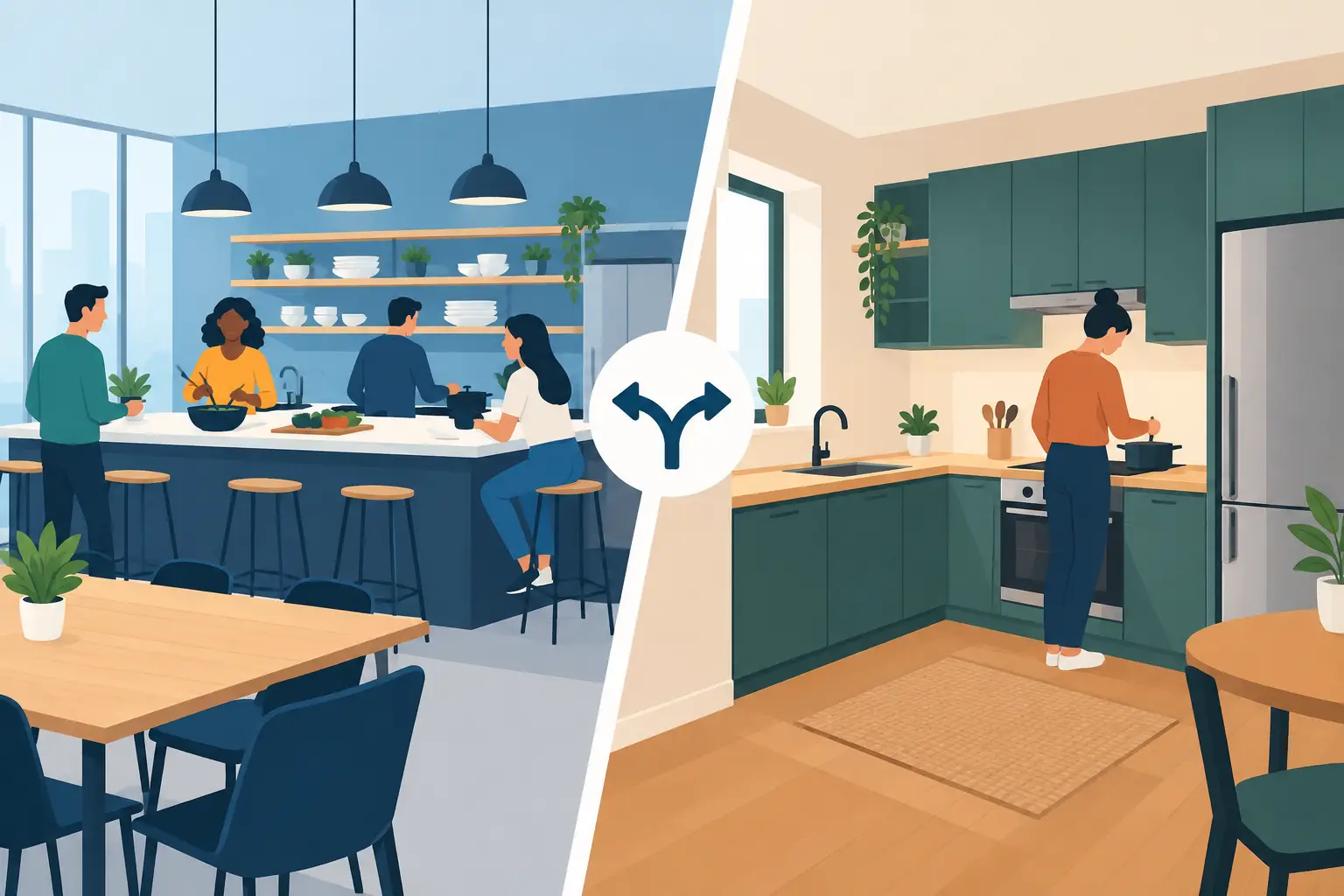
A kitchen decision can determine whether a delivery brand reaches operational stability quickly or spends its first six months correcting expensive constraints. In the UAE, the choice between shared versus private kitchens is not simply about monthly rent. It affects licensing, staffing, menu design, delivery radius, platform performance, food cost control, and the ability to grow without disrupting service.
For founders, restaurant operators, and investors, the right answer depends on the stage of the business and the level of control the model requires. A shared kitchen can reduce the cost and timeline of market entry. A private kitchen can create stronger operational control and long-term capacity. Neither is automatically the better choice. The commercial case must be tested against the brand’s demand forecast, unit economics, and execution plan.
A shared kitchen gives multiple food businesses access to a professionally equipped production facility. Operators typically rent a station, a defined production area, or scheduled kitchen access. Some facilities include common storage, cleaning, utilities, and basic equipment, while others charge separately for cold storage, dry storage, extraction, waste handling, or additional equipment.
A private kitchen gives one operator dedicated control over the premises and workflow. This can be a standalone commercial kitchen, a dedicated cloud kitchen unit, or an underused restaurant kitchen converted for delivery production. The operator controls access, equipment layout, staffing patterns, prep schedules, inventory processes, and operating standards within the licensed space.
The practical difference is control. Shared kitchens exchange a degree of control for lower upfront commitment and faster activation. Private kitchens require more capital and management discipline, but they allow a business to design the operation around its own menu, volume profile, and growth targets.
A shared kitchen is usually most effective when the business needs commercial validation before committing to a fixed facility. This is particularly relevant for first-time founders, new virtual brands, and restaurant groups testing a delivery concept outside their existing trade area.
The first advantage is speed. An established facility may already have much of the infrastructure required for food production. That can reduce the time spent on fit-out, equipment procurement, utilities coordination, and site preparation. It does not eliminate licensing and compliance work, but it can make the launch path more manageable when the facility structure supports the intended activity.
The second advantage is capital protection. Instead of funding a full fit-out, extraction system, refrigeration package, and long lease commitment, an operator can preserve capital for working inventory, packaging, staff training, marketplace setup, launch promotions, and the cash buffer required during the first months of trade. This matters because delivery brands rarely fail solely because of kitchen rent. They fail when weak contribution margins, platform commissions, poor availability, and inconsistent ratings consume cash faster than the business can recover.
Shared space can also work well for brands with low or uncertain order volume. A concept selling 20 to 40 daily orders does not necessarily need a fully dedicated facility. The question is whether the kitchen can support peak periods, prep requirements, and dispatch standards without creating delays.
However, shared kitchens are not low-risk by default. Founders should confirm the operating conditions before signing. A lower rental figure can become costly if the kitchen has limited storage, restricted access hours, poor equipment availability, long lift routes for riders, or peak-time congestion. The facility may also limit menu categories, cooking methods, packaging activity, or branding visibility.
A shared kitchen is strongest when it is treated as a controlled test environment, not an informal shortcut. Set a validation period, define target order volume and contribution margin, measure customer ratings, and establish the point at which dedicated capacity becomes commercially justified.
The core operational risk in a shared facility is dependency. Your brand’s performance can be affected by conditions you do not fully control: another operator using key equipment, crowding during peak hours, common-area hygiene failures, delayed waste collection, or inconsistent facility management.
For delivery, these issues appear directly in marketplace metrics. If preparation time rises, orders may be delayed or canceled. If a station is too small for efficient mise en place, food quality can fall during the evening rush. If stock is stored across multiple common areas, portioning and availability become harder to manage. A customer sees a late order or a missing item. The platform sees lower operational reliability.
Shared facilities can also complicate brand standardization. A multi-brand operator needs repeatable recipes, fixed prep procedures, clear allergen controls, accurate inventory counts, and consistent training. When space is tight or equipment is shared, teams often create workarounds. Those workarounds may keep service moving temporarily, but they are difficult to scale and even harder to audit.
This does not mean a shared model cannot support meaningful sales. It means the operator must assess the facility like an operating asset, not just a rental option. Visit during actual lunch and dinner peaks. Map the journey from receiving to storage, prep, cooking, packing, rider handover, and cleaning. The kitchen should support the workflow required by the menu, not force the menu to fit a compromised workflow.
A private kitchen becomes more compelling when order volume is proven, menu complexity is high, or the operator needs tighter control over quality and capacity. It is often the better choice for established brands, high-volume delivery concepts, multi-brand portfolios, and restaurant operators converting idle production capacity into additional revenue.
The upfront cost is higher. A dedicated unit may require a lease commitment, deposits, fit-out, equipment, utility setup, approvals, licenses, staffing, and maintenance planning. Those costs must be modeled before signing, along with realistic opening timelines and working capital requirements.
But private space can improve unit economics at sufficient volume. The operator can organize stations around actual demand, invest in equipment that removes production bottlenecks, schedule prep earlier, hold more inventory, and create a packing line designed for delivery accuracy. Better workflow can reduce ticket times, waste, remakes, and labor pressure at peak periods.
Dedicated space also provides control over the customer promise. Brands can standardize recipes, hold packaging inventory, manage food safety procedures, and train staff against one operating system. This is especially valuable when a business depends on ratings recovery, repeat orders, or premium pricing. A delivery brand cannot position itself as reliable if its kitchen setup produces inconsistent outcomes.
Private kitchens are not only for new cloud kitchen sites. A restaurant with underused daytime or late-night capacity may have a more attractive route: build delivery-only brands from its existing kitchen. This can be commercially efficient if the current layout, extraction, equipment, storage, staffing, and licensing scope can support the added demand. The opportunity is real, but it should not be assumed. Adding virtual brands without capacity planning can damage the restaurant’s core operation and create marketplace issues across every brand.
The decision should be based on more than rental comparisons. A lower monthly rent may be the wrong choice if it caps sales or damages service quality. A private facility may look expensive until the model shows that its capacity, workflow, and margin improvement support the fixed cost.
Build the comparison around four operational questions:
Then test the assumptions against realistic platform economics. Include commissions, discounts, sponsored visibility, payment fees where applicable, refunds, delivery packaging, and menu-level food costs. Delivery revenue is not the same as operating profit. A structured feasibility model should show the sales level at which each kitchen option becomes viable and the downside if volume arrives later than planned.
Location also matters. A kitchen’s rent is only one part of its commercial value. Delivery radius, rider access, traffic patterns, building access, parking, and proximity to demand zones can affect conversion, delivery times, and customer experience. A cheaper kitchen in the wrong catchment may create a permanent growth ceiling.
For many operators, the most disciplined route is staged. Start in shared space when the objective is menu validation, marketplace learning, and demand testing. Move to private space when volume, margins, and operating requirements justify the fixed commitment. For an existing restaurant, use available capacity first when it can be separated operationally and measured clearly.
The transition should be planned before it becomes urgent. Once a brand is regularly losing orders because of capacity constraints, the move is already late. Track daily orders, peak-hour throughput, preparation times, cancellation reasons, ratings, repeat-order patterns, labor productivity, and stock-outs. These metrics reveal whether the problem is demand, menu design, staffing, or kitchen capacity.
FoodWork approaches kitchen selection as part of a wider launch and growth system: feasibility, licensing, site suitability, workflow, menu economics, platform onboarding, and post-launch performance must work together. A kitchen is not the business model. It is the operating base that must support it.
Choose the space that gives the business enough control for its current stage, with a clear route to the next one. The best kitchen decision is the one that protects capital early, preserves service quality at peak demand, and allows growth to be earned through measurable performance rather than assumed from day one.
Get clarity before you commit capital.

+971 52 288 5400
2101, Court Tower, Business Bay, Dubai UAE
hello@foodwork.ae
© 2026 FoodWork. All rights reserved
