
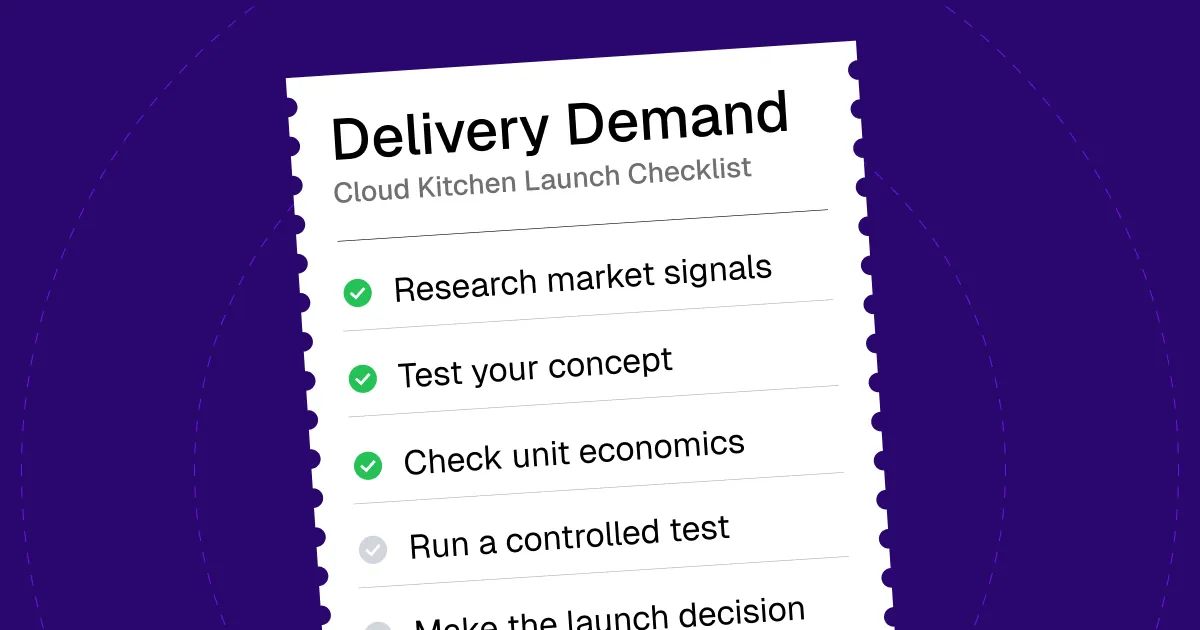
How to validate delivery demand is the question to answer before any lease, licence or equipment order. Validation means proving that customers in a specific area will order your cuisine, at your price, in enough volume to cover the cost of producing it.
A promising food concept is not proof that customers will order it. In the UAE delivery market, the real question is how to validate delivery demand before signing a kitchen agreement, hiring a team, or committing capital to a launch. Demand must be proven at the neighborhood, price-point, platform, and operational level.
A delivery brand can receive positive feedback from friends and still fail on aggregators. It may be entering a crowded cuisine category, relying on a basket size that does not cover delivery economics, or serving food that declines during a 25-minute ride. Proper validation turns those risks into decision-ready evidence.
Do not test whether people generally like your cuisine. Define a commercial hypothesis that can be proven or rejected. For example: office workers and residents within a defined Dubai delivery radius will order a premium, healthy lunch bowl between AED 38 and AED 52, with an average basket above AED 65 and sufficient margin after marketplace costs.
That statement creates measurable questions. Which neighborhoods will produce the orders? Which dayparts matter? What customer need are you serving better than existing brands? What price can the market support? What minimum weekly order volume makes the operation viable?
A broad concept creates broad research and weak decisions. A narrow hypothesis lets you compare real marketplace conditions with the financial model. It also prevents founders from investing in a menu, kitchen format, or location before identifying what actually drives repeatable orders.
Delivery demand is local. A cuisine that performs well in Dubai Marina may not have the same order profile in Jumeirah Village Circle, Business Bay, Sharjah, or Abu Dhabi. Population density, office concentration, household mix, competing listings, traffic patterns, and delivery fees all change the opportunity.
Start by reviewing the major delivery platforms as a customer would. Search relevant cuisines, dishes, price bands, and dietary claims during breakfast, lunch, dinner, and late-night periods. Record the brands that repeatedly appear near the top, their delivery times, rating levels, visible promotions, menu depth, and customer review themes.
High competition is not automatically a reason to avoid a category. It can indicate established demand. The concern is unmanaged competition: a market where every listing looks interchangeable, discounts are permanent, and the leading brands have stronger rating volume, better photography, and faster delivery coverage than a new entrant can realistically match.
Look for gaps that are commercially meaningful. A gap may be an under-served daypart, a missing format such as family bundles, a weak value proposition in a specific price tier, or poor execution among brands serving a proven cuisine. “No one is doing it” is not enough. Sometimes no one is doing it because customers do not order it at scale.
Social engagement, Google searches, and food trends can help shape a concept, but they do not confirm paid delivery behavior. Delivery customers make decisions under time pressure. They compare cuisine familiarity, visible value, delivery time, ratings, promotions, and menu clarity in seconds.
Use social and search signals to identify emerging interest. Use aggregator data, competitor order proxies, customer interviews, and test campaigns to establish whether that interest converts into orders at an economically viable price. The difference matters. A dish can be highly shareable yet poorly suited to delivery frequency.
Customer interviews work best when they are structured around recent behavior. Ask people what they ordered in the last seven days, from which platform, at what time, for how many people, and why they selected that brand. Ask what disappointed them and what would make them switch.
Avoid asking, “Would you order this?” Most people will be encouraging. Instead, test choices: would they replace an existing lunch order with your offer at your intended price and delivery time? Their current behavior is more reliable than stated interest.
Demand that loses money is not demand worth scaling. A commercial feasibility model should calculate contribution per order before fixed operating costs, then show the order volume required to cover rent, labor, utilities, packaging, technology, licenses, and management.
For each proposed item, model the selling price against food cost, packaging, platform commission, payment charges where applicable, discounts, delivery subsidies, waste, and variable labor. Then test the result at realistic average order values, not just single-item orders.
A concept often appears attractive when its headline menu prices are compared only with ingredient cost. It becomes less attractive when marketplace deductions and promotional pressure are included. In some categories, customers expect a discount to try an unfamiliar brand. If the model only works without that discount, the launch plan is too fragile.
Use at least three cases: conservative, expected, and strong. The conservative case should assume a slower order ramp, lower average basket, and a higher promotional requirement. If the business only survives in the strong case, revise the offer before committing to a full launch.
A tasting in a kitchen is not a delivery test. The customer receives the food after production, packing, rider collection, travel, and sometimes a delay at the building entrance. That is the product you need to validate.
Run controlled test orders across the intended radius and at different peak periods. Check temperature, texture, leakage, portion appearance, labeling, assembly errors, and how well the dish photographs on arrival. Measure ticket-to-ready time and rider handoff time as well. A strong dish that takes too long to produce can reduce platform visibility and damage the customer experience during busy periods.
Keep the first menu focused. A smaller menu provides cleaner learning because each item has a purpose: acquire customers, create a high-margin add-on, raise basket value, or generate repeat orders. Large launch menus often hide which items are carrying demand and which are creating waste, complexity, or poor ratings.
Packaging deserves the same discipline as recipe development. The least expensive pack is not always the lowest-cost option if it causes soggy food, spills, or negative reviews. Test it against the journey your customer will experience, not against the counter presentation.
When possible, validate through a limited launch rather than a full kitchen commitment. Existing restaurant capacity, a shared commercial kitchen, or a managed cloud-kitchen setup can create a lower-risk testing environment. The goal is not maximum revenue in week one. The goal is reliable evidence.
Set a test period long enough to see more than opening curiosity. Four to six weeks can reveal whether orders hold after initial promotions, which dayparts convert, and whether customers reorder. A shorter test can still be useful for product and pricing feedback, but it is weaker evidence of sustained demand.
Track a concise operating scorecard:
Do not judge results by total orders alone. A brand generating 30 daily orders with a healthy contribution margin, rising ratings, and repeat purchases may be more investable than one generating 60 discounted orders with refunds and poor retention.
Validation should end with a decision, not a folder of observations. Set thresholds before the test starts. These should cover demand, economics, and execution.
A go decision may require repeat orders from the target zone, a sustainable average basket, acceptable contribution after normal promotional activity, and consistent operational performance. An adjust decision may mean the cuisine has demand but the menu pricing, packaging, delivery radius, or production process needs correction. A stop decision is equally valuable when the required order volume is unrealistic or customer feedback shows no compelling reason to switch.
This discipline protects capital. Founders often continue because they have already spent on branding, equipment, or licensing. A controlled validation process makes it easier to change direction while the cost of change is still manageable.
The first error is treating a competitor’s visibility as proof of profitability. A highly ranked brand may be spending heavily on promotions, operating with thin margins, or benefiting from an established review base that a new listing does not have.
The second is confusing a strong launch with durable demand. Friends, opening offers, and paid placement can produce early sales. Watch what happens when discounts normalize and customers have had time to reorder.
The third is ignoring execution capacity. Demand cannot be separated from operational reality. If staffing, prep systems, inventory control, or rider handoff are inconsistent, a good concept can quickly accumulate low ratings that restrict its marketplace performance.
For UAE operators, validation is most useful when it connects market research to a practical launch plan: the right kitchen capacity, a focused menu, a viable delivery radius, accurate platform setup, and controlled improvement cycles after launch. FoodWork approaches this as an execution question, not just a research exercise.
The best time to challenge your assumptions is before the lease, not after it. Build evidence one layer at a time, and let the numbers determine whether to launch, refine, or walk away.
The fastest validation route in the UAE is a short live test from an existing licensed kitchen, either a shared facility or a managed partner. You list a focused menu, spend a controlled amount on visibility, and measure real orders rather than opinions.
Run the test for at least four weeks so you see a full cycle of weekdays, weekends and paydays. Track conversion from impressions, average basket, repeat rate and contribution per order. If contribution per order does not cover a realistic share of fixed costs at the volume you achieved, the concept needs repricing or repositioning before it scales.
Use this summary when you need to explain the process to a partner or an investor.
Founders who validate delivery demand this way commit capital with evidence rather than optimism, and they enter lease negotiations knowing the volume the site must support. Market context for UAE food businesses is published by Dubai Municipality for licensing, and platform dashboards supply the demand side once a test listing is live.
Four to six weeks. Shorter tests miss weekday and weekend patterns, payday effects and the drop that follows a platform’s new-listing visibility boost.
Use a licensed shared or managed kitchen for a limited menu. You pay for capacity by the month rather than building a facility, and you can stop after the test.
The number that covers fixed costs with contribution to spare at your price point. Calculate break-even orders first, then judge the test against that figure rather than a generic benchmark.
No. It reduces the largest risk. Execution, capacity and rating management still decide whether the concept holds up once volume rises.
Testing two focused menus can work if the kitchen can produce both at peak. Testing five dilutes attention and produces data you cannot act on.
That is a pricing or positioning problem. Discount-dependent demand rarely becomes profitable at scale, because the discount has to grow as competition increases.
Our feasibility and financial blueprint structures this validation, and virtual brand launch runs the live test from a licensed kitchen.

Get clarity before you commit capital.

+971 52 288 5400
2101, Court Tower, Business Bay, Dubai UAE
hello@foodwork.ae
© 2026 FoodWork. All rights reserved
