
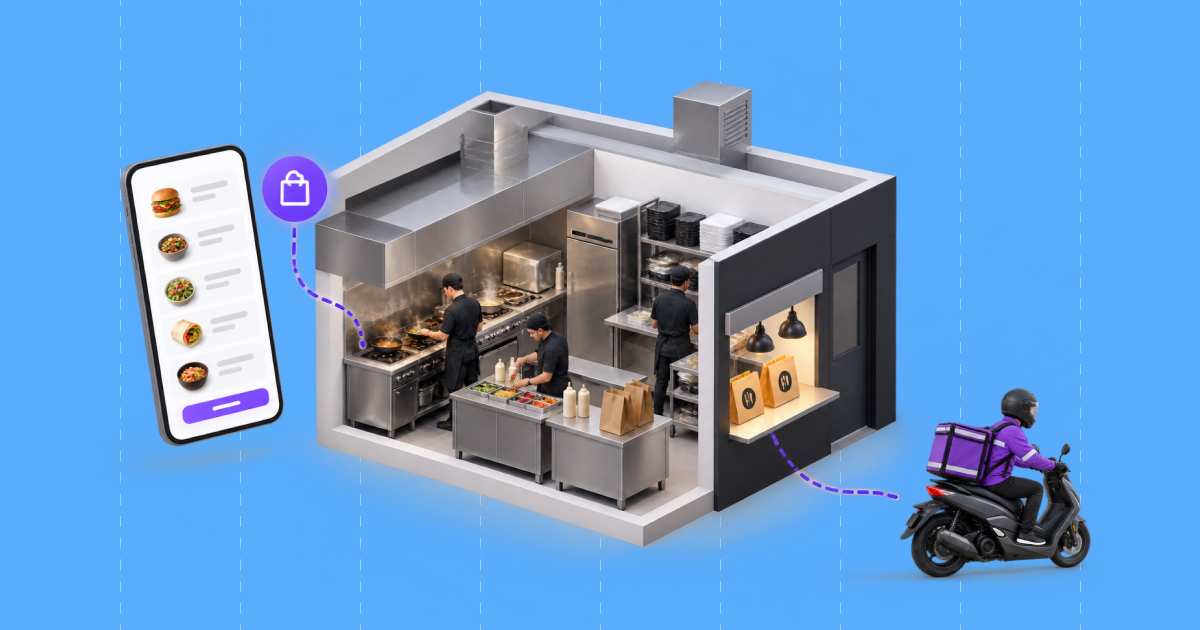
What is a ghost kitchen? It is a production kitchen that sells only through delivery apps and its own channels, with no dining room, no service staff and no walk-in trade. The model trades customer-facing presence for lower fixed costs and faster launch.
A delivery brand can look successful on an aggregator long before its economics are proven. Orders may arrive, the menu may photograph well, and promotions may create early momentum. But if food cost, labor, packaging, commissions, refunds, and prep capacity have not been controlled, that activity can produce revenue without producing a viable business.
That is the commercial question behind what is a ghost kitchen. It is not simply a restaurant without tables. It is a delivery-first operating model that replaces the dining room with a production kitchen, digital storefronts, and disciplined marketplace execution.
For founders and restaurant operators in the UAE, the model can reduce the capital tied up in front-of-house fit-out and prime retail space. It also concentrates risk in areas that need active management: kitchen throughput, menu engineering, platform visibility, order accuracy, and contribution margin.
A ghost kitchen is a commercial food-production facility that prepares meals for delivery or pickup without operating a traditional dine-in restaurant. Customers discover the brand through delivery apps, a direct ordering channel, social media, or search, then receive their order at home or work.
The term is often used interchangeably with cloud kitchen, dark kitchen, virtual kitchen, and delivery-only kitchen. In practice, the structure matters more than the label. A ghost kitchen may be a dedicated unit producing one brand, a shared facility housing several operators, or an existing restaurant kitchen using spare capacity to run additional delivery brands.
Unlike a conventional restaurant, the customer experience is shaped almost entirely by the digital menu, food photography, price architecture, delivery time, packaging, and the condition of the order when it arrives. There is no host, dining room, or service recovery at the table. A missing side, late order, or poor presentation is visible in ratings and repeat-order behavior immediately.
A delivery-only business usually has four connected operating layers: demand generation, order capture, food production, and delivery handoff. Each layer affects the next, so the model should be designed as one operating system rather than a collection of outsourced tasks.
Demand is generated through aggregator platforms, paid placements, organic visibility, repeat customers, and sometimes direct channels. The digital storefront must convert: clear brand positioning, relevant search terms, competitive pricing, appetizing images, and a menu that is easy to understand on a mobile screen all matter.
Once an order is placed, the kitchen must produce it within the promised preparation time without compromising quality. This is where a delivery-first menu differs from a dine-in menu. Items need to travel well, hold their texture and temperature, use manageable ingredient sets, and fit the available equipment and staffing structure.
Finally, orders are packed, verified, and handed to riders. While the delivery platform may control rider allocation, the restaurant still influences the customer outcome through realistic prep times, accurate handoff processes, packaging quality, and order completeness.
A dedicated ghost kitchen gives an operator control over equipment, workflow, staffing, and brand standards. It can be the right choice when forecasted volume justifies a committed site and the concept requires specialized production.
A shared or rented commercial kitchen lowers initial capital requirements and can shorten the path to launch. The trade-off is less control over layout, storage, access, and sometimes operating hours. Operators need to assess whether the facility can support their production volumes and compliance requirements rather than choosing on rent alone.
A virtual brand uses capacity inside an existing restaurant kitchen. For a restaurant owner, this can be a practical way to monetize underused labor, equipment, and ingredients. It only works when the new brand has a distinct customer proposition, does not disrupt the core operation, and can be executed consistently during peak periods.
The main advantage is a more focused cost structure. Without a customer-facing location, operators may avoid expensive dining-room fit-out, furniture, service staff, and the pressure to secure a high-footfall site. That can make testing a focused concept more accessible than opening a full-service restaurant.
The model can also support faster brand iteration. A founder can test whether a shawarma concept, healthy bowl brand, dessert line, or specialty burger offer has enough demand before committing to a large physical footprint. Established operators can use the model to enter new meal occasions or customer segments without changing their primary dine-in identity.
However, lower front-of-house investment does not mean low operating complexity. Delivery businesses trade dining-room costs for platform commissions, digital marketing spend, packaging, kitchen rent, technology, and a higher dependence on online reputation. The right question is not whether a ghost kitchen is cheaper. It is whether the forecasted contribution margin can support the complete delivery cost base.
A delivery brand should be built around unit economics before its menu is uploaded. Gross sales are an incomplete measure of health. Operators need to understand what remains after direct food cost, packaging, taxes where applicable, aggregator charges, discounts, payment costs, labor, and kitchen occupancy costs.
Discounting is a common pressure point. Promotions can improve trial and platform visibility, but permanent discounting can train customers to buy only when margins are weakest. A controlled offer should have a purpose, a duration, and a clear measure of success, such as first-order conversion, basket-size growth, or repeat purchase.
Menu breadth is another issue. A large menu can appear attractive online but often creates slower prep times, excess inventory, inconsistent quality, and avoidable waste. The strongest delivery menus are usually engineered around a smaller set of products with shared ingredients, clear modifiers, reliable packaging, and adequate gross margin.
Capacity must also be tested honestly. A kitchen that handles 20 orders an hour in a quiet period may fail at 50 orders during lunch or dinner peaks. Delays then damage acceptance rates, customer satisfaction, platform ranking, and staff morale at the same time. Production mapping, station design, batch preparation, and peak-hour staffing should be planned before launch, not after ratings decline.
A controlled launch starts with feasibility, not branding. Before signing a kitchen agreement or investing in equipment, define the target customer, meal occasion, competition, expected order value, price range, operational requirements, and realistic demand assumptions. The result should be a decision-ready financial blueprint, not a broad revenue estimate.
Licensing and kitchen selection come next. The facility needs to suit the concept’s equipment, extraction, storage, delivery access, and staffing needs, while the business setup must align with local licensing and food-safety requirements. In the UAE, these details can affect launch timing and cost materially, so they should be coordinated early.
The menu should then be costed item by item. This includes recipe yield, portion control, packaging, platform pricing, and promotional scenarios. A price that looks competitive but cannot carry its delivery costs is not a market entry strategy.
Platform onboarding is also an operational task, not just an administrative one. Store hours, prep-time settings, menu categories, modifiers, images, stock availability, and customer support processes all influence conversion and rating performance. The first weeks should be treated as a measurement period, with daily attention to cancellations, unavailable items, late orders, complaints, and customer feedback.
The answer to what is a ghost kitchen becomes clearer after opening: it is a performance business. It needs regular operating reviews, not occasional marketing activity.
Track sales alongside the indicators that explain sales quality: average order value, conversion, food cost percentage, labor cost, prep time, cancellation rate, refund rate, rating, repeat orders, and contribution margin. A sales increase driven by deep discounts and late deliveries is not the same as sustainable growth.
Use controlled improvement cycles. If ratings fall, isolate the cause before changing everything at once. The issue may be packaging, a single weak menu item, rider wait time, incorrect order assembly, or an unrealistic preparation setting. Correct the process, monitor the result, and protect the change through staff training and daily checks.
For restaurant owners, virtual brands should receive the same discipline. Idle capacity is valuable only if the additional volume improves profitability without reducing the quality or speed of the existing business. Separate prep zones, inventory controls, brand-specific packaging, and clear production priorities can prevent one concept from weakening another.
A ghost kitchen can be an efficient route into delivery, but it is not a shortcut around restaurant operations. The strongest operators treat the model as a coordinated commercial system: validate demand, build for the real cost base, launch with control, and improve using evidence. That is where an execution partner such as FoodWork can add value – by connecting setup decisions with the daily operating work that protects revenue after launch.
The term covers several operating structures, and the differences matter for cost, control and licensing.
Most first-time founders in Dubai start with a shared kitchen because it removes fit-out capital and municipality approval delay, then move to a private unit once volume justifies dedicated capacity.
The launch cost is only half the question. Ongoing economics decide whether the model works. Commission on delivery platforms typically runs at a significant share of each order, packaging is a real per-order cost, and rider-ready packing adds labour minutes that dine-in kitchens do not carry.
Plan the operating budget around four lines: food cost, platform commission and promotion funding, packaging, and labour per produced order. If contribution margin after those four lines does not cover rent and overhead at your realistic order volume, the concept needs repricing or a different menu before it launches. You can model a launch budget with our cloud kitchen setup cost calculator.
Food businesses in Dubai must hold a trade licence with a food activity and food safety approval from Dubai Municipality, and food handlers need valid health cards and food safety training, whichever format you choose.
The terms are used interchangeably in the UAE. Both describe delivery-only production with no dine-in area. Cloud kitchen is the more common term in the region, while ghost kitchen and dark kitchen appear more often in North American and European coverage.
They can be, when order volume, menu pricing and commission are modelled together. Profit comes from contribution margin per order at realistic volumes, not from low rent alone. Concepts that price for dine-in margins usually lose money once commission and packaging are deducted.
Many delivery-only concepts operate in 200 to 800 square feet, depending on menu complexity, storage and the number of brands produced. Menu design drives the requirement more than brand count, because equipment and prep stations follow the cooking methods you choose.
Usually not a separate trade licence, but each brand must be registered correctly on the delivery platforms and produced from an approved kitchen. Requirements differ by emirate, so confirm the structure before listing multiple brands from one unit.
A shared kitchen can be trading within weeks. An independent unit usually takes several months once licensing, fit-out, equipment lead times and platform onboarding are sequenced properly.
A single-brand operation often starts with a head cook, one or two commis and a packer at peak. The packing and dispatch role is the one most operators underestimate, and it is the one that protects preparation time and ratings.
If you are weighing formats, our feasibility and financial blueprint sizes the model for your concept, and end-to-end cloud kitchen setup takes it from licence to launch.
Get clarity before you commit capital.

+971 52 288 5400
2101, Court Tower, Business Bay, Dubai UAE
hello@foodwork.ae
© 2026 FoodWork. All rights reserved
