
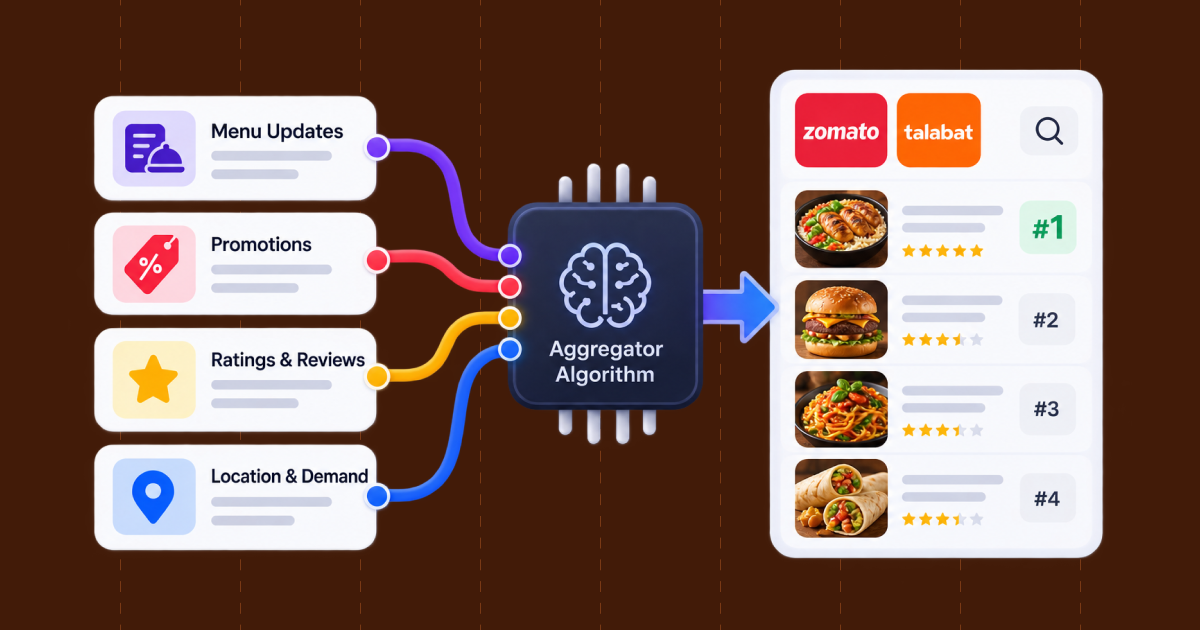
A delivery brand can lose order volume without changing its menu, kitchen, or marketing budget. One week it appears consistently in relevant customer searches. The next, it slips below stronger competitors, paid placements become more expensive, and a previously reliable daypart weakens. Aggregator algorithm changes are often the reason, but the commercial damage usually comes from how slowly the operator identifies and responds to them.
For UAE cloud kitchens and delivery-first restaurant brands, marketplace ranking is not a passive channel issue. It directly affects revenue, food cost recovery, kitchen labor efficiency, and the return on every promotional dirham. The practical question is not whether a platform will change its ranking logic. It will. The question is whether the business has the operating controls to protect conversion and recover visibility without discounting its way into weaker margins.
Delivery platforms do not publish a fixed, permanent formula for where every restaurant appears. Their systems are designed to improve customer outcomes: relevant choice, dependable fulfillment, strong value perception, and repeat ordering. That means the factors influencing visibility can be adjusted by location, category, time of day, customer behavior, platform strategy, and competitive density.
A change may not look like a formal platform announcement. It may show up as lower impressions for a high-performing item, reduced placement in a cuisine category, a fall in conversion despite stable menu traffic, or a greater share of orders coming from sponsored exposure. Operators who treat this as random platform behavior often make expensive decisions. They cut price, add broad discounts, or rebuild the menu before establishing what actually changed.
The better approach is to view marketplace performance as a controlled operating system. Rankings are influenced by signals the kitchen can manage, signals the platform controls, and signals created by the local competitive market. The goal is not to guess the algorithm. It is to build a brand that continues to perform when the weighting of those signals shifts.
While every aggregator uses its own logic, delivery platforms tend to reward evidence that a customer will have a good ordering experience. That evidence is operational, not cosmetic.
A brand cannot rank consistently if it is frequently unavailable, rejects orders, pauses during peak periods, or runs out of its best-selling items. Availability is especially important for virtual brands operating from shared or existing kitchens. If the parent restaurant prioritizes dine-in production during dinner service, the delivery brand may be technically listed but commercially unreliable.
Set availability according to real production capacity, not aspirational sales targets. A controlled pause is sometimes preferable to accepting orders that will leave late, incomplete, or poorly packed. However, repeated pauses at the same high-demand hours should trigger a capacity review, not become normal practice.
Estimated delivery time shapes both customer choice and platform confidence. A kitchen that consistently misses its quoted preparation time creates a poor customer experience before the food reaches the door. Long prep times can also reduce order acceptance by delivery partners and increase cancellations.
The answer is not simply to promise shorter times. It is to measure the production path from ticket acceptance to handoff. Identify bottlenecks in batch preparation, fryer capacity, assembly, packaging, and rider collection. In many cloud kitchens, the most useful improvement is a narrower peak-hour menu that protects speed and quality rather than a larger menu that creates avoidable queue time.
Ratings are a visible proxy for trust, but the average score alone is not enough. A brand with a respectable rating can still lose conversion if recent reviews mention cold food, missing items, poor packaging, or inconsistent portions. Those comments tell future customers what to expect, and they often point to the operating issue limiting repeat orders.
Review recovery should be handled as an operational program. Categorize complaints by root cause, assign ownership, correct the kitchen or packaging process, and monitor whether the issue falls over the following weeks. Responding politely to a review has value, but it does not replace fixing a recurring failure.
When visibility drops, operators often assume they need more traffic. In reality, a weak conversion rate can be the larger problem. If customers see the brand but do not order, the menu may be unclear, priced poorly against its local set, or structured without obvious entry points.
Menu engineering should focus on decision-making. Use clear item names, descriptions that remove uncertainty, accurate modifiers, strong hero products, and logical category order. Photography matters where the platform supports it, but it cannot compensate for a menu with no price ladder, no recognizable signature, or bundles that erode margin without improving basket value.
A disciplined response begins with a simple performance comparison: the seven, 14, and 28 days before the decline against the same periods after it. Look at impressions, menu visits, conversion rate, order volume, average order value, cancellation rate, acceptance behavior, preparation time, rating movement, promotional spend, and contribution margin.
The pattern matters. If impressions have fallen while conversion remains stable, the issue is likely visibility, competitive movement, availability, or a platform placement change. If impressions are stable but conversion falls, investigate pricing, menu structure, ratings, delivery estimates, and recent customer feedback. If orders are steady but margin is falling, promotional dependency, commission structure, item mix, and food cost need attention.
Do not assess the full week as one number. Break the data down by platform, delivery zone, daypart, cuisine category, and brand. A lunch decline in one neighborhood may be caused by a new competitor or an office-demand shift, while a dinner decline across zones may indicate a broader platform or operational issue.
The most common mistake after aggregator algorithm changes is reacting with permanent discounts. Discounts can restore conversion in specific situations, but they also retrain customers to wait for offers and can hide a weak operating signal. Any promotion should have a defined purpose, a duration, and a margin threshold.
Start with the least destructive interventions. Restore stock discipline on high-converting items, correct inaccurate preparation times, remove low-performing menu complexity, and resolve repeat complaint causes. Then test commercial changes with a clear hypothesis. For example, improve a bundle to increase average order value, adjust a price point where conversion has weakened, or use a targeted offer during a low-utilization daypart.
Each test should have a baseline and a review date. If a campaign adds orders but lowers contribution after food cost, packaging, commission, and discount funding, it is not a growth win. It is paid volume. For a delivery-first business, revenue quality matters as much as gross sales.
Marketplace management becomes unreliable when it is handled only after sales decline. A weekly review creates early warning and gives founders a fact base for decisions.
Review commercial performance alongside operations. Check platform ranking positions for key customer searches in priority delivery zones, but do not treat a manual search as complete evidence. Also review sales by daypart, availability hours, out-of-stock incidents, prep-time variance, cancellations, ratings, review themes, menu conversion, average order value, and promotion profitability.
The review should end with named actions rather than observations. If packaging complaints rise, specify the packaging change, owner, kitchen shift, and verification method. If a hero item has low conversion, assign a menu or pricing test. If dinner preparation time is drifting, adjust staffing, prep volume, or production flow before the next peak period.
For multi-brand and multi-kitchen operators, this discipline is even more valuable. It prevents one struggling brand from consuming marketing budget while a better-performing concept is underfunded or constrained by production capacity. FoodWork applies this type of structured review across platform, menu, and kitchen performance because marketplace growth only holds when the operation can fulfill it consistently.
No operator can control every marketplace decision. Platforms will test new placements, adjust category logic, prioritize different customer behaviors, and change the economics of paid visibility. The businesses that hold up best are not those chasing every rumored algorithm update. They are the ones with accurate data, controlled kitchen execution, commercially credible menus, and enough margin discipline to test changes without damaging the business.
When platform visibility moves, respond with evidence rather than urgency. A clear diagnosis, a limited test, and a weekly control cycle will usually outperform a rushed discount campaign – and leave the brand stronger for the next change.

Get clarity before you commit capital.

+971 52 288 5400
2101, Court Tower, Business Bay, Dubai UAE
hello@foodwork.ae
© 2026 FoodWork. All rights reserved
