
Menu engineering and optimization

Your menu decides what customers order, what the kitchen can execute at peak and what you keep after commission and packaging. We rebuild it around all three, using recipe costing, sales data, competitor pricing and the way the delivery platforms behave.

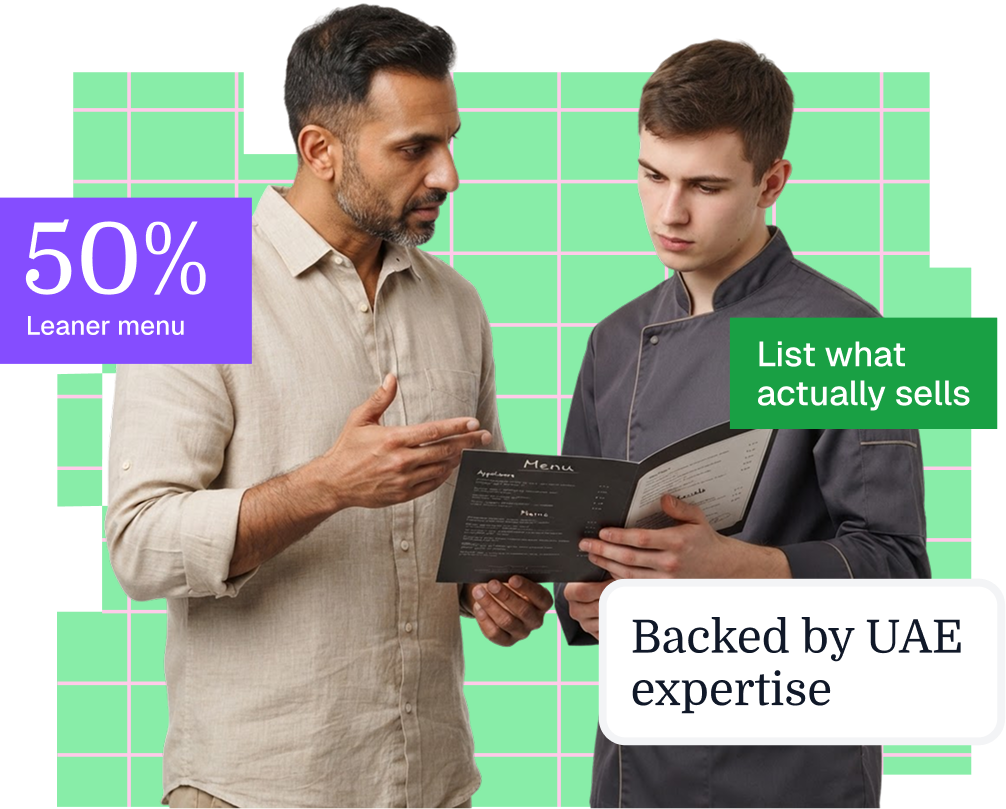
FoodWork consultant and chef reviewing a cloud kitchen menu during a menu engineering session in Dubai

What menu engineering is

Menu engineering assesses every item on popularity, selling price, variable cost and contribution, then decides whether to promote it, improve it, reprice it, reposition it or remove it. It is the difference between a menu built from recipes and instinct and one built to earn. Most menus carry bestsellers that contribute almost nothing, profitable dishes nobody sees, more items than the kitchen can execute consistently, and discounts nobody has costed.

One cloud kitchen, before and after the menu rebuild

A single brand operating from a shared kitchen in Dubai, listed on four aggregators. Nothing changed in the kitchen, the location or the ad spend. Only the menu.

 
Before
310
orders a week

Sixty-eight items on the menu, nine of which carried almost every order. The rest absorbed prep time, stock and shelf space, and the discounts covering them were never costed.

  • Menu items 68
  • Average order value AED 41
  • Contribution after commission and packaging 11%
  • Average preparation time 23 min
  • Platform rating 3.9
After twelve weeks
570
orders a week

Thirty-four items built around what actually sold, repriced per channel, with add-ons and bundles placed where customers were already deciding. Prep got faster, so ratings moved with it.

  • Menu items 34 50% leaner
  • Average order value AED 57 39%
  • Contribution after commission and packaging 24% 13 points
  • Average preparation time 14 min 9 min faster
  • Platform rating 4.6 0.7

Where the extra orders came from

The same kitchen as the comparison above, tracked weekly across its three delivery platforms. Total orders moved from 310 to 570 a week over twelve weeks. Nothing changed in the kitchen, the team or the ad spend. Only the menu.

 
0 150 300 450 600 Orders per week 0 1 2 3 4 5 6 7 8 9 10 11 12 Week 275 more orders a week by week 12 Menu unchanged Menu rebuilt with FoodWork 0 150 300 450 600 Orders per week 0 2 4 6 8 10 12 Week
  • Menu rebuilt with FoodWork310 to 570 orders a week
  • Menu left unchanged310 to 295 orders a week

Agreed scope against your concept and the data available

You receive a written menu audit, item level costing and contribution analysis, competitor and price benchmarking, recommended selling prices by channel, a revised category and item structure, an add-on and bundle plan, naming and description recommendations, an aggregator ready menu and a priority action plan in the order it should be executed.

Menu audit and item diagnosis

Every item reviewed for pricing gaps, duplication, weak products and unnecessary complexity, working from your sales mix where the business is already trading.

Food costing and contribution

Recipe level food cost, packaging and variable costs verified, then items ranked by what they contribute rather than by food cost percentage.

Competitor and market benchmarking

Brands in your delivery zone compared on cuisine, price band, ratings, structure, portions and offers, so you compete on evidence rather than imitation.

Pricing strategy by channel

Prices set against cost, target contribution, customer expectation, competitor benchmarks and the commission that applies on each platform.

Item naming and descriptions

Names and descriptions that explain the product, the key ingredients and the serving size, written for your website, QR menus and each delivery app.

Kitchen and ingredient efficiency

Ingredient cross utilization, preparation steps, equipment and bottlenecks, so the menu stays practical for the team during peak hours.

Add-ons, combos and order value

Upgrades, sides, sauces, beverages, desserts, premium sizes and family bundles placed where the customer is already deciding.

Delivery and aggregator optimization

Travel quality, holding time, packaging, preparation speed and margin after commission, plus the aggregator-ready structure for onboarding.

You do not need historical sales data to start.

What changes is the evidence the menu is built from.

The same work suits cafés, bakeries, dessert and beverage concepts, international brands adapting a menu for the UAE market, and operators preparing for a relaunch or a new location.

Launching a new brand

The commercial structure is set before the first order, using competitor analysis, recipe costing and the real limits of the kitchen you will work in.

An operating restaurant

We work from what the business already holds: POS sales, aggregator orders, prices, discounts, costs, ratings and feedback from the floor.

Cloud kitchens and virtual brands

Menus built for online discovery, quick decisions and margin that still survives commission, discounting and packaging.

A menu engineered just for your brand

Six stages, in order. Each produces something the next one depends on.


01

Discovery

Concept, customer, cuisine, kitchen, channels and objectives, plus your sales and costing records where they exist.

02

Market review

Comparable brands, price levels, ratings, delivery presence and the category openings inside your trade area.

03

Costing and analysis

Product costs, margins, popularity, platform economics and the specific places revenue is being left behind.

04

Menu strategy

The recommended product mix, pricing, structure, modifiers, bundles and the order in which to act on them.

05

Implementation

Menu finalisation, aggregator structuring, packaging guidance, photography direction and launch preparation.

06

Review

We read the results after the change and recommend the next round of adjustments from actual customer behaviour.

What founders usually ask us before they start

What is the difference between menu engineering and menu design?

Menu engineering decides what you sell, what each item costs, what it contributes, how it is priced and where it appears. Menu design is the visual layout. We build the commercial structure and can provide design direction or coordinate the design work within the agreed scope.

Is this only for restaurants that are already open?

No. An operating business gives us sales data to work from. A pre-launch brand is built instead from competitor analysis, recipe costing, price positioning and the practical limits of the kitchen you will be working in, which removes most of the trial and error from the opening months.

Can you work on our Talabat or Deliveroo menu?

Yes. We review category order, item selection, pricing, descriptions, modifiers, add-ons, bundles, delivery suitability and the margin that remains after platform commission and packaging. The same approach applies to Careem, Noon Food and Keeta.

How does menu engineering improve profitability?

It exposes the relationship between how often an item sells and what it actually contributes. That lets the business promote the strong items, repair thin margins, correct pricing, add relevant upgrades and remove the complexity and waste that were never paying for themselves.

Do you provide food costing and price recommendations?

Yes. Depending on scope and the data available, we assess ingredient cost, packaging cost, other variable costs and contribution, then recommend selling prices for dine in, takeaway and each delivery channel.

Will you remove items from our menu?

Only where the evidence supports it, and the decision stays yours. An item may be kept, repriced, resized, renamed, repositioned, reformulated, bundled or withdrawn depending on the financial and operational role it plays.

Does this work for a multi-brand cloud kitchen?

Yes. We work across the brands together, improve shared ingredient usage, reduce duplicated preparation and keep each brand distinct enough that customers do not see the same kitchen behind three listings.

How long does a menu engineering project take?

It depends on the number of items, the number of brands, whether recipes and sales data are ready, and whether new menu development or implementation is included. We confirm the timeline after the initial review rather than before it.

What do you need from us to start?

Your current menu, your recipes or ingredient lists if they exist, recent sales or aggregator reports if the business is operating, and a short conversation about the kitchen, the team and where you want the brand to sit in the market.

Turn your menu into a commercial structure

Whether you are launching a delivery brand or repairing a menu that is already live, we can tell you what every dish is doing for the business and what to change first.