
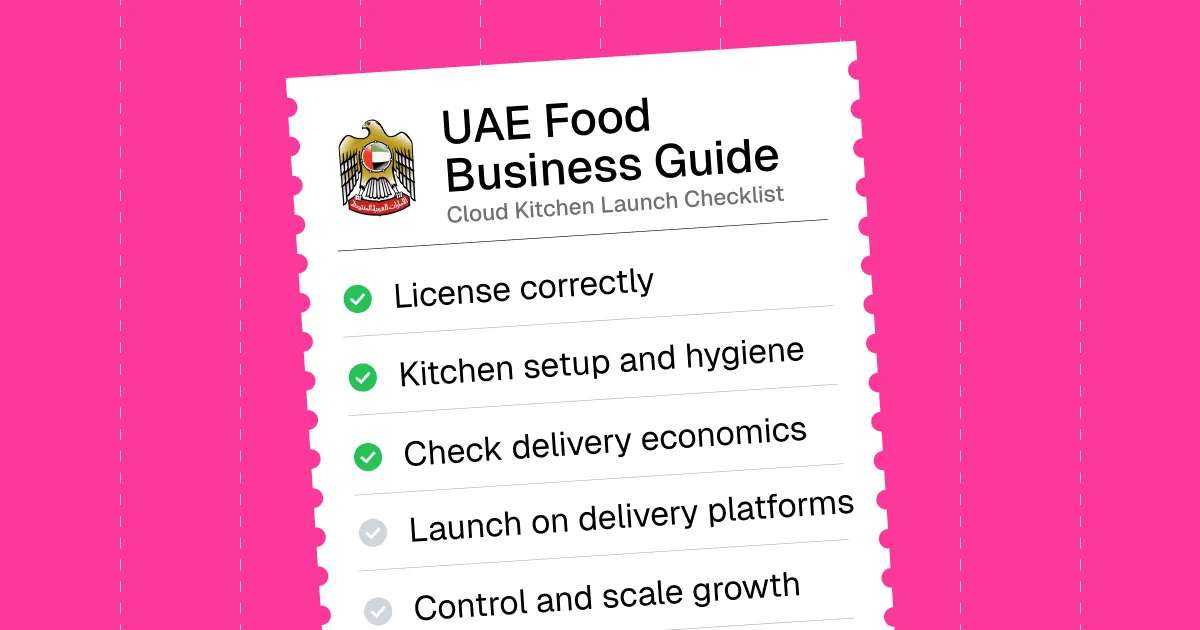
This UAE food business guide sets out the sequence that protects cash: validate demand, confirm the licensing route, size the kitchen to the menu, launch on delivery platforms deliberately, and only then scale. Most costly mistakes come from doing these steps in the wrong order.
A delivery brand can look promising on paper and still lose money from its first week of trading. In the UAE, the gap usually appears between the concept and the operating model: a menu built for dine-in is placed on delivery platforms, kitchen capacity is misread, fees are underestimated, or licensing and onboarding take longer than the launch plan allows. This UAE food business guide is built for founders and operators who want to control those decisions before fixed costs and platform discounts begin to compound.
The opportunity is real. Dubai and the wider UAE have mature delivery demand, high customer expectations, and an established aggregator ecosystem. But market access does not equal commercial viability. A controlled launch starts with evidence, builds the operating model around delivery realities, and treats the first 90 days as a measured improvement cycle rather than a finish line.
The first question is not whether a cuisine is popular. It is whether a specific customer occasion can produce repeatable, profitable orders in a defined delivery radius.
A feasibility assessment should test demand, competition, pricing, menu fit, delivery distance, and achievable sales volume. For example, a premium burger concept may have strong category demand, but the local trade area may already be crowded with highly rated brands using aggressive discounting. A differentiated offer, better bundle structure, or a tighter operating zone may be needed before the concept can support its costs.
Build the financial model from contribution margin, not from headline sales. Each order must absorb food cost, packaging, aggregator commission or delivery-related fees, payment costs where applicable, discounts, kitchen rent, labor, utilities, marketing, and waste. Then assess how many orders per day are required to cover fixed costs and generate an acceptable return.
This work also identifies the right format. A dedicated cloud kitchen can offer focus and operational control, but it carries a new fixed-cost base. Operating from an existing restaurant kitchen can reduce setup cost and monetize idle capacity, but only if the extra production does not damage the core restaurant’s speed, quality, or staff workload. The right answer depends on capacity, location, capital, and the strength of the existing operating team.
Many avoidable losses begin with a lease or kitchen agreement signed before the workflow has been designed. A suitable kitchen is not simply a compliant room with extraction. It must support the menu, order peaks, storage needs, dispatch flow, and service-hours plan.
For a delivery-first business, assess the production line from receiving to dispatch. Where will dry, chilled, and frozen goods sit? Can prep happen without blocking hot-line production? Is there enough refrigeration for par levels during peak periods? Can completed orders remain organized without drivers crowding the pass? A kitchen that appears large enough can become inefficient when several delivery platforms send orders at the same time.
The commercial agreement matters as much as the physical setup. Review rent structure, utility treatment, maintenance responsibilities, access hours, notice periods, exclusivity conditions, shared-space rules, and what equipment is included. A lower monthly rate may be less attractive if the facility limits operating hours, has inadequate storage, or requires major equipment additions.
Before committing, validate four operating checkpoints:
Licensing should run in parallel with concept, kitchen, and entity planning. It should not be treated as an administrative task to solve after the kitchen is selected.
Requirements vary by emirate, business structure, activity, facility, and whether the operation is delivery-only, restaurant-based, or using a shared kitchen. In Dubai, founders commonly need to coordinate trade licensing, food establishment approvals, facility documentation, food safety requirements, and staff-related compliance. Depending on the setup, additional approvals, tenancy documents, signage requirements, or partner documentation may apply.
The key operational lesson is sequencing. An entity name or commercial activity may be acceptable in one context while the kitchen arrangement, menu category, or facility documentation creates a later bottleneck. Confirm the full approval path before investing in fit-out, equipment, branding, or launch marketing.
Food safety cannot be separated from commercial execution. Recipe specifications, supplier standards, allergen controls, receiving procedures, temperature records, cleaning routines, and staff training all affect consistency. They also protect ratings. A single recurring packaging failure or food-quality complaint can reduce platform conversion well before it becomes an obvious operational crisis.
A delivery menu is a production and margin system, not a digital copy of a dine-in menu. Every item should be evaluated for travel performance, assembly time, ingredient overlap, packaging cost, upsell potential, and contribution margin.
Start with a narrow core menu. Too many low-volume items increase inventory, training time, prep complexity, and waste. A focused menu lets the team build repeatable execution, identify winners quickly, and maintain better stock control. Add range only when the base operation is stable and customer demand supports it.
Test the food after realistic delivery time, not immediately after plating. Fried products can soften, sauces can separate, cold items can warm, and drinks can leak. Packaging is therefore part of the product. It must protect temperature and presentation without adding unnecessary cost or slowing the packing line.
Pricing also requires discipline. Competitor prices provide context, but they do not determine what your business can charge. Set prices against the required margin after direct order costs, then create bundles that raise average order value without relying on permanent discounting. A well-designed meal for two or add-on side can improve economics more reliably than a blanket promotion.
Aggregator onboarding is not merely a listing exercise. Brand naming, imagery, menu architecture, modifiers, operating hours, preparation times, availability settings, and promotional mechanics all influence customer conversion and operational performance.
At launch, protect execution before chasing volume. If the kitchen cannot sustain a high order spike, extended wait times, rejected orders, substitutions, and poor reviews can quickly suppress visibility. Begin with realistic hours, capacity settings, and delivery zones. Expand when the team is consistently meeting service standards.
Track performance at item and platform level. The most useful early indicators are impressions, menu conversion, average order value, acceptance rate, cancellation rate, preparation time, customer rating, refund reasons, and repeat-order behavior. Revenue alone can hide a weak business if sales are being bought through discounts or if poorly performing items create refunds and negative feedback.
When ratings fall, diagnose the cause before responding with more promotions. Review customer comments, order timing, packing errors, stock-outs, late handoffs, and item-specific complaints. A rating recovery plan should target the failure point with controlled changes: revised prep procedures, better packaging, menu edits, staff retraining, or capacity limits during the busiest periods.
The first three months should produce decisions, not just sales data. Set a weekly review rhythm covering revenue, order volume, margin, platform metrics, food cost, labor, waste, customer feedback, and operational incidents. Compare actual results with the original feasibility model, then adjust one or two variables at a time.
This is where many founders lose control. They add menu items, extend hours, increase discounts, switch suppliers, and launch on more platforms at once. When performance changes, they cannot tell which action caused it. Controlled improvement cycles preserve visibility: test a price adjustment, a revised bundle, a new product image, or a packaging change, then measure the result before making the next move.
For established restaurants, virtual brands can be a practical growth route when they are built around genuine excess capacity and compatible ingredients. They are not a shortcut to additional profit. The brand must have a distinct customer proposition, a delivery-ready menu, dedicated workflow rules, and clear accountability for platform performance. Otherwise, it simply adds complexity to an already busy kitchen.
FoodWork approaches launch as one connected operating program: feasibility, licensing coordination, kitchen readiness, menu economics, marketplace setup, and post-launch performance management. That coordination matters because the decisions made in one stage determine the risk in the next.
The strongest UAE food businesses do not launch with the largest menu or the loudest promotion. They launch with a clear commercial model, a kitchen that can execute it, and enough measurement to improve without guessing. Build that control before opening the tablets, and growth becomes a management decision rather than a hope.
Every food business in the UAE needs a trade licence with a food activity from the economic department of the emirate it operates in, plus food safety approval for the premises. In Dubai, food establishment requirements and inspection standards are published by Dubai Municipality, while Abu Dhabi and Sharjah apply their own processes through their respective authorities.
Staff need valid occupational health cards and food safety training, and the kitchen must meet fit-out, extraction and civil defence requirements. Confirm all of this before committing to a unit, because a cheap kitchen that cannot be approved is the most expensive option available.
Used in order, this UAE food business guide keeps capital in reserve until the concept has evidence behind it, which is exactly what investors and landlords want to see.
A trade licence with a food-related activity from the economic department of the emirate, plus food safety approval for the kitchen premises. Requirements and fees differ by emirate and by activity.
Yes, provided the facility is licensed for food production and your brand is registered correctly on the delivery platforms. Shared kitchens are the fastest legal route to trading for most first-time founders.
It varies by emirate, unit and activity. Plan for weeks rather than days, and keep rent liability in the cash flow for the approval window.
Yes. Food handlers require valid health cards and food safety training, and the person in charge must meet the local authority’s requirements.
Confirm the building permits food use, extraction meets the standard, civil defence requirements are satisfied, and the landlord will supply the documents your licence application needs.
Enough to cover at least six months of trading below forecast, plus the approval period before revenue begins.
Start with the setup cost calculator, then let our end-to-end setup team take the launch from licence to first order.
Get clarity before you commit capital.

+971 52 288 5400
2101, Court Tower, Business Bay, Dubai UAE
hello@foodwork.ae
© 2026 FoodWork. All rights reserved
