
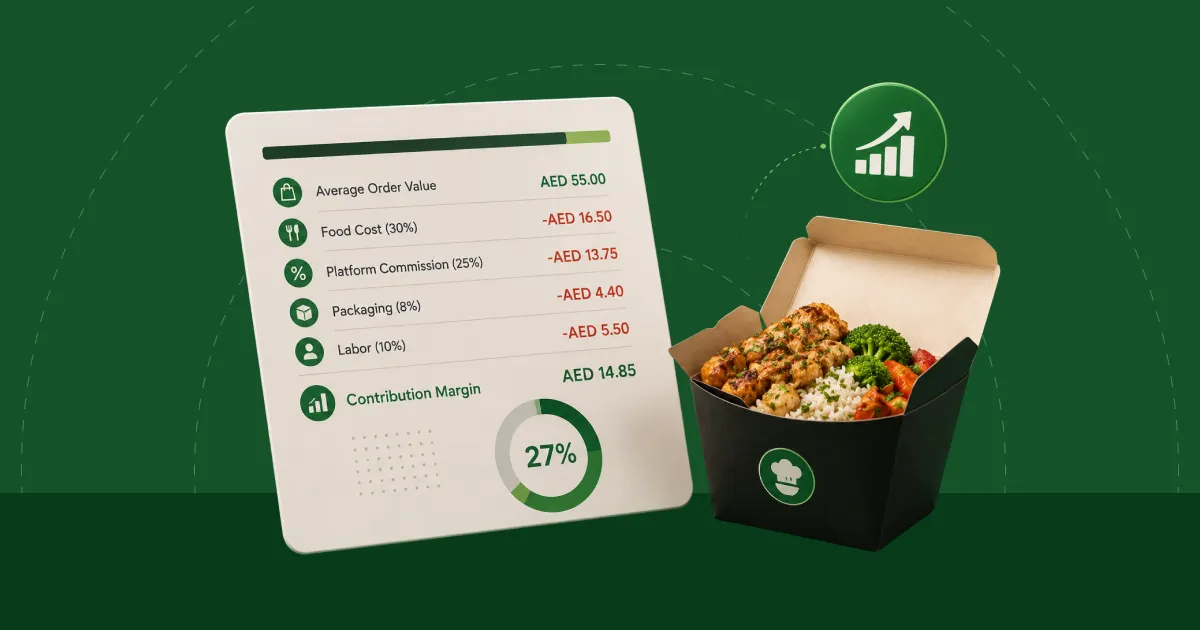
How to calculate contribution margin for a delivery order: take the price the customer pays, then subtract food cost, platform commission, any discount you funded and packaging. What remains is contribution, and it is the only number that tells you whether volume is making you money.
A delivery brand can look busy on an aggregator dashboard and still lose money with every additional order. Knowing how to calculate contribution margin gives founders a faster commercial test: after the costs that move with an order are paid, how much is left to cover the kitchen and create profit?
For a UAE cloud kitchen, this is not an accounting exercise to revisit at month-end. It is a daily operating metric that should shape menu prices, platform promotions, packaging choices, staffing plans, and growth decisions. A product with strong sales but weak contribution can consume kitchen capacity that a better-performing item could use.
Contribution margin is the revenue remaining after subtracting variable costs. These are costs that rise when an additional order is produced and delivered. The remaining amount contributes toward fixed operating costs such as base kitchen rent, permanent management salaries, licenses, software, and central overhead.
The basic formula is:
Contribution Margin = Sales Revenue – Variable Costs
Contribution margin can be measured in AED per item, per order, per brand, or across the full operation. For most delivery-first operators, the most useful starting point is contribution margin per order and per menu item. It shows whether growth is commercially useful before fixed costs are considered.
The percentage version helps compare items with very different price points:
Contribution Margin Percentage = Contribution Margin / Sales Revenue × 100
A high average order value does not automatically mean a healthy margin. A AED 75 order with expensive ingredients, heavy packaging, a platform-funded discount, and a 30% commission may contribute less than a AED 42 order with disciplined food cost and a simpler operating flow.
Start with the customer-facing selling price, then work backward through every cost directly caused by fulfilling that sale. Use net revenue, not the price displayed before discounts. If a customer receives a AED 10 discount funded by the brand, that AED 10 reduces revenue.
For example, assume a burger meal sells for AED 48 on a delivery platform. The brand funds a AED 4 promotion, so net sales revenue is AED 44.
Its variable costs are AED 13.20 for food ingredients, AED 2.80 for packaging, AED 11.00 for platform commission and payment-related charges, AED 1.50 for direct order-level kitchen labor, and AED 0.70 for order-specific consumables and wastage.
Total variable cost is AED 29.20. The calculation is:
AED 44.00 net revenue – AED 29.20 variable costs = AED 14.80 contribution margin per order
The contribution margin percentage is:
AED 14.80 / AED 44.00 × 100 = 33.6%
That AED 14.80 is not net profit. It must still contribute to rent, utilities, supervisors, licenses, technology, marketing retainers, and other fixed costs. But it gives management a clear answer to a critical question: does this sale improve the business before overhead?
Aggregator reporting can make revenue look larger than the amount available to the brand. Build the calculation from the commercial agreement and settlement statement, not assumptions. Check whether commission is applied before or after VAT, whether discounts are brand-funded, platform-funded, or shared, and whether delivery fees affect your payout.
A platform-funded customer offer may improve conversion without reducing your revenue in the same way as a brand-funded discount. A shared campaign needs its actual cost allocated to each redeemed order. These distinctions matter because promotion costs can change the margin of a top-selling item overnight.
For a delivery-food business, variable costs commonly include food and beverage ingredients, packaging, condiments, platform commissions, payment fees, order-level promotional funding, and direct per-order labor where applicable. Include spoilage or remakes when they are predictable consequences of order volume or menu complexity.
Do not automatically classify every kitchen cost as variable. Monthly kitchen rent, a fixed kitchen manager salary, annual licensing, and a standard software subscription generally remain fixed within a normal operating range. Including them in every item calculation can hide which products are genuinely worth selling.
There are exceptions. If a high-volume growth plan requires an extra shift, an additional station, or incremental hourly staff, that added labor is variable for the decision being made. Cost classification depends on the time frame and the operating decision, not simply on the name of the expense.
A practical model should be simple enough for operators to update weekly and detailed enough to identify margin leakage. Create one row for each menu item and capture gross price, discount, net revenue, recipe cost, packaging, commission, promotional cost, direct labor, and contribution margin in AED and percentage terms.
Then group items into categories such as mains, sides, beverages, bundles, and add-ons. This makes it easier to spot where margin is created. In many cloud kitchens, beverages and add-ons carry strong contribution percentages, while oversized bundles or heavily discounted hero products may dilute the order.
Recipe costing needs discipline. Use current purchase prices, standardized portion weights, yield loss, and actual vendor pack sizes. A sauce that appears to cost AED 0.60 per portion can cost materially more once over-portioning, waste, and inconsistent prep are included. If the cost data is unreliable, the margin result is only a confident-looking guess.
Packaging deserves the same attention. Delivery brands often understate it by counting only the primary container. Include lids, seals, bags, cutlery where used, napkins, labels, and thermal protection. A packaging upgrade may reduce refunds and improve ratings, which can justify the higher cost. The right decision depends on whether the improvement protects enough revenue and repeat demand to offset the margin reduction.
Contribution margin becomes valuable when it leads to controlled action. Review it before launching a new menu item, joining an aggregator promotion, changing a supplier, or expanding delivery radius.
A low-margin product is not always a product to remove. It may bring customers into the brand, support a bundle with profitable add-ons, or improve conversion at a key price point. But those reasons should be tested, not assumed. Track whether it increases average order value, repeat orders, or profitable cross-selling.
Similarly, raising price may improve margin per order while reducing conversion. A AED 3 increase on a best seller is only beneficial if the resulting sales decline does not erase the added contribution. Test price changes in controlled cycles, using comparable days and periods rather than reacting to one weekend of sales.
The metric also helps determine whether a promotion is viable. If an item contributes AED 16 before a AED 6 brand-funded discount, the promotion reduces contribution to AED 10 before any uplift in volume is considered. The campaign needs enough incremental, profitable orders to justify that reduction. Orders that would have happened without the discount do not create incremental value.
Once you know average contribution margin per order, you can estimate the order volume needed to cover fixed monthly costs.
Break-Even Orders = Fixed Costs / Average Contribution Margin per Order
If a kitchen has AED 90,000 in monthly fixed costs and its weighted average contribution margin is AED 18 per order, it needs 5,000 orders per month to break even. That is roughly 167 orders per day in a 30-day month.
This calculation should be treated as a planning baseline, not a guarantee. Average contribution changes with the sales mix, discounting level, platform commission structure, ingredient inflation, and operational waste. A growth plan built on a single optimistic margin assumption is fragile. A decision-ready financial blueprint uses conservative, base, and upside scenarios so the founder can see how much room the business has when performance moves.
The first mistake is using menu price instead of net received revenue. The second is calculating food cost from memory rather than standardized recipes and current invoices. The third is ignoring marketplace costs because they appear later in the settlement report.
Another common error is averaging too early. A brand-level margin can look healthy while its most visible products are unprofitable. Review item-level contribution first, then category, channel, daypart, and brand performance. Dine-in pickup, direct orders, and aggregator orders may have very different economics for the same dish.
Finally, do not confuse contribution margin with cash flow. A business can have positive unit contribution and still face cash pressure from supplier payment terms, deposits, inventory purchases, refunds, or delayed platform settlements. Both views are required to operate with control.
The most useful contribution margin model is one your kitchen, finance, and growth teams can act on together. When every new dish, discount, and platform campaign is measured against real order economics, growth becomes a commercial choice rather than a volume chase.
Run the calculation per item, not only per average order. Averages hide the items that lose money at every sale, and those items are usually the ones promoted hardest because they look popular.
Once each item has a contribution figure, sort the menu into four groups: high contribution and high volume, high contribution and low volume, low contribution and high volume, and low contribution and low volume. Promote the first group, fix pricing or portioning in the third, reposition the second with photography and placement, and remove the fourth.
This is the core of menu engineering, and it is the fastest structural improvement most UAE delivery kitchens can make without spending a dirham on marketing.
Model the whole picture with our setup cost calculator, then apply the results through menu engineering.
It depends on your fixed cost base and order volume. Rather than chasing a benchmark, calculate the contribution needed to cover fixed costs at realistic volume, then set item targets from that figure.
No. Gross profit usually deducts food cost only. Contribution margin also deducts commission, packaging, funded discounts and variable labour, which is why it reflects delivery reality better.
Channel pricing is common and usually necessary, because delivery carries costs dine-in does not. Keep the difference defensible and within platform policy.
Bundles usually raise contribution per order even at a discount, because commission scales with value while packaging and labour barely move.
Monthly, and whenever supplier prices, packaging costs or platform terms change. A stale calculation leads to confident but wrong decisions.
The menu is priced for the wrong channel. Rebuild around fewer items with stronger margins before adding volume through promotions.
Our menu engineering service rebuilds delivery menus around contribution, and growth services keeps promotions inside margin.

Get clarity before you commit capital.

+971 52 288 5400
2101, Court Tower, Business Bay, Dubai UAE
hello@foodwork.ae
© 2026 FoodWork. All rights reserved
