
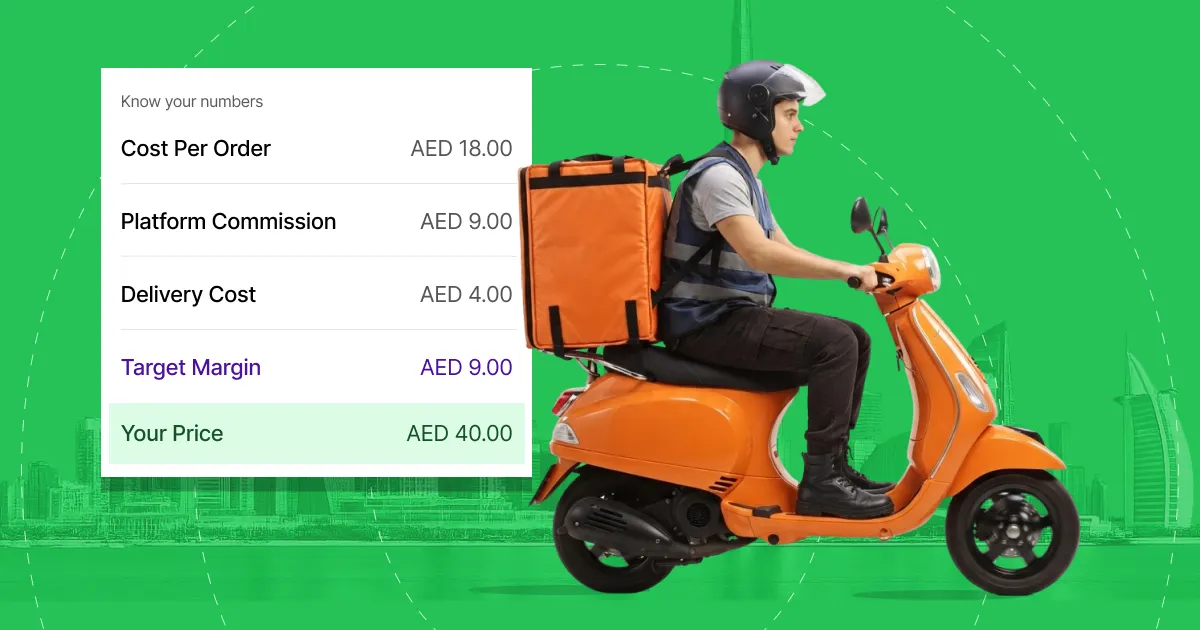
A delivery brand can be busy all day and still lose money on every order. That is the central risk a food delivery pricing strategy must control. In the UAE, where aggregator commissions, paid visibility, discounts, packaging, and delivery expectations shape customer behavior, menu prices cannot be copied from a dine-in operation or set by intuition.
A commercially sound price is not simply the highest amount a customer might accept. It is the price that funds food quality, reliable packaging, kitchen labor, platform costs, and controlled growth while remaining credible beside competing listings. Getting there requires a structured operating view of each item, each sales channel, and each promotion.
The first pricing error happens before a menu goes live: founders calculate food cost, add a markup, and assume the result is profitable. Delivery economics require a wider cost stack.
For every menu item, establish the fully loaded variable cost. This includes ingredients, recipe yield loss, packaging, sauces and disposables, transaction or payment costs where applicable, aggregator commission, and any per-order delivery subsidy paid by the business. Add the labor directly required to produce and pack the item if it moves materially with order volume.
Then separate fixed costs from variable costs. Kitchen rent, core management salaries, licenses, utilities, software, photography, and baseline marketing do not belong in a single item recipe cost. They do, however, need to be recovered through the overall contribution generated by the menu. A brand with attractive item-level margins can still fail if its average order value and order volume cannot absorb those fixed commitments.
The useful question is not, “What food cost percentage should we target?” It is, “How much contribution does this order produce after every cost that rises when it is sold?” That contribution must be sufficient to fund overhead and produce an acceptable operating return.
A practical pricing floor starts with the desired contribution per item or per order. If an item costs AED 14 in ingredients and packaging, carries a 30% commission, and needs to leave AED 12 in contribution before fixed costs, its selling price cannot be AED 35. At AED 35, the commission is AED 10.50, leaving just AED 10.50 after direct costs.
The calculation should work backward:
Minimum selling price = (direct food and packaging cost + required contribution) ÷ (1 – platform commission rate – other percentage-based costs)
This is a decision tool, not a substitute for judgment. It reveals whether an item is viable, whether the recipe needs redesign, or whether the business must increase basket size to make the order work. If the floor is materially above the market’s accepted price, lowering the price is rarely the answer. The product, portion, sourcing, packaging, or channel model needs to change.
A single menu price across every channel may feel simple, but it can hide costly differences. Orders from a direct channel, an aggregator marketplace, a corporate catering lead, and a dine-in counter do not carry the same acquisition cost, commission burden, fulfillment expectations, or customer behavior.
Aggregator pricing should account for the commercial terms of that platform and the cost of maintaining visibility within it. Direct-channel pricing can reflect lower commission costs, but it should not be discounted so aggressively that it creates distrust or trains customers to abandon marketplaces only when they expect a deal. The objective is not to punish a channel. It is to preserve a rational margin structure across channels.
For restaurant operators adding a virtual brand from existing kitchen capacity, channel economics are especially important. Shared labor and rent can improve profitability, but only if the new brand has distinct demand, manageable prep times, and prices that account for incremental packaging, ingredients, and marketplace spending. Idle capacity is valuable. It is not free capacity.
Customers assess a menu as a system. A few strategically designed entry items can bring customers into the listing, but the menu must guide them toward combinations that improve contribution.
Anchor items establish the perceived value of the cuisine. Core sellers should carry dependable margin and operational consistency. Add-ons such as drinks, sides, sauces, and desserts can raise average order value with relatively low incremental labor. Bundles can make the customer’s decision easier while protecting profitability better than a broad percentage discount.
This is where many delivery menus underperform. They list individual dishes without defining the desired order. A customer buys one main item, pays a delivery fee, and leaves the kitchen with a low-value ticket. A better menu makes a complete meal the natural choice through clear bundles, relevant modifiers, and packaging formats built for groups or repeat occasions.
Price endings and tier gaps matter, but not as much as operational logic. A AED 39 main that reliably produces a AED 62 basket with a side and beverage can be more valuable than a AED 35 main that attracts discount-driven single-item orders. Measure what customers actually place in the cart, not only what they click.
Promotions can create trial, improve placement, and reactivate customers. They can also turn a viable brand into a volume-heavy loss center. A discount should never be treated as generic marketing activity. It is an investment with a defined funding source, target audience, duration, and success metric.
Before joining a platform campaign, calculate the net order value after the discount, commission, campaign fee, food cost, packaging, and any subsidized delivery component. Then decide what the campaign is intended to achieve. A launch offer may be justified if it generates ratings, repeat orders, and enough data to refine the menu. A recurring discount for customers who would have ordered anyway is simply margin leakage.
Use promotions selectively. First-order offers are useful when the brand can convert trial into a second purchase. Bundle-led offers work when they raise the basket instead of reducing the price of an already profitable order. Slow-day campaigns can help smooth kitchen utilization, provided the team can fulfill the extra volume without delayed orders or declining food quality.
Avoid stacking discounts without a clear net-margin view. Platform-funded offers, merchant-funded discounts, free-delivery contributions, loyalty redemptions, and paid placement can overlap. Each may look manageable alone. Together, they can reduce the contribution of a AED 70 basket to almost nothing.
A menu item can be popular and still be commercially damaging. Fragile dishes, long assembly times, high waste ingredients, and items that travel poorly create hidden costs through refunds, lower ratings, remakes, and customer churn.
Pricing decisions should therefore sit alongside menu engineering and kitchen workflow. If a dish requires complex assembly during peak periods, either price it for that labor burden, simplify the build, limit availability, or remove it. If packaging is essential to preserve quality, treat it as part of the product cost, not an optional overhead line.
This matters strongly on aggregators because customer ratings influence conversion and visibility. A low-priced item that arrives cold, spills, or takes too long to prepare can damage the listing beyond the value of the sale. Controlled growth depends on delivering what the menu promises at the price paid.
Revenue is a useful headline metric, but it is not a pricing decision metric. Review item and channel performance weekly using contribution after variable costs, average order value, conversion, discount dependency, refund rate, prep time, and repeat-order behavior.
Look for patterns. If sales rise while contribution falls, a promotion or cost change may be eroding the model. If conversion is weak despite competitive pricing, the problem may be imagery, menu clarity, ratings, delivery time, or poor value communication rather than price. If one item sells heavily but produces little contribution, it may need a recipe adjustment, a new bundle role, or a controlled price increase.
Price testing should be deliberate. Test one meaningful change at a time, hold the measurement period long enough to account for weekday patterns, and compare contribution rather than gross sales alone. Small changes in portioning, add-on attachment, bundle design, or selected item prices can produce stronger results than a broad menu increase that disrupts demand.
For new cloud kitchens, the most disciplined approach is to set an opening price architecture, validate it through early operating data, and run controlled improvement cycles. FoodWork applies this type of revenue-focused execution across menu design, platform performance, and managed operations because pricing is not a one-time launch task. It is an operating system that must keep pace with food costs, competitor activity, platform terms, and real customer behavior.
The right next move is to price one complete order from end to end, including every channel cost and every promotional deduction. That single exercise often shows whether the business is building revenue or building avoidable pressure on its margin.

Get clarity before you commit capital.

+971 52 288 5400
2101, Court Tower, Business Bay, Dubai UAE
hello@foodwork.ae
© 2026 FoodWork. All rights reserved
