
A cloud kitchen feasibility study answers one question with evidence: will this concept, in this area, at this price, produce enough contribution to cover its costs? It combines demand analysis, licensing reality, capital requirements and unit economics into a single investment decision.
A delivery kitchen can look profitable on a spreadsheet long before it proves it can win orders at a sustainable margin. A cloud kitchen feasibility study UAE founders can rely on must test more than market demand. It must establish whether a specific concept can be licensed, produced consistently, discovered on delivery platforms, and operated within a cost structure that leaves room for profit.
For founders, restaurant operators, and investors, feasibility is not a presentation prepared to justify a decision already made. It is a commercial control document. It identifies the assumptions that need proof before a lease, license application, equipment order, or staffing commitment turns into an expensive fixed cost.
A decision-ready study should answer one central question: can this food business generate repeatable delivery revenue at an acceptable operating margin in its intended catchment area?
That question has several connected parts. A concept may have strong customer appeal but fail on food cost. A well-designed menu may work operationally but suffer from weak marketplace visibility. A low-rent kitchen may look attractive until delivery distances create poor food quality, long delivery times, and low ratings.
The feasibility process should therefore assess demand, location, menu fit, operating capacity, legal setup, startup capital, and monthly unit economics as one system. Treating each item separately is how founders approve a kitchen before confirming whether the model can support it.
The UAE delivery market is active, but demand is not evenly distributed across every cuisine, price point, or delivery zone. A study should define the primary catchment area around the proposed kitchen and assess the relevant customer behavior within it.
This means reviewing competing brands on the major delivery marketplaces, their menu structures, pricing, ratings, promotions, delivery times, and customer feedback. The objective is not simply to count competitors. It is to identify where the market is crowded, where customers are underserved, and whether a new brand has a credible reason to be selected.
For example, a generic burger offer may face a high cost of visibility in a saturated area. A focused late-night menu, a premium office-lunch proposition, or a cuisine with limited reliable options may have a clearer entry point. The answer depends on the zone, target audience, and platform behavior, not broad statements about a cuisine category.
A menu designed for a dine-in restaurant does not automatically translate to delivery. The feasibility study should review whether each core item holds its quality through packaging, preparation, dispatch waiting time, and the final delivery journey.
The best delivery menu is not necessarily the largest one. It is a controlled range of items that can be prepared quickly, presented consistently, and sold at a price that protects contribution margin. Every additional SKU creates more inventory exposure, training requirements, prep complexity, and risk of order errors.
Menu testing should examine recipe cost, portion control, packaging cost, waste risk, and preparation time. It should also assess basket-building opportunities such as sides, beverages, bundles, and desserts. A healthy average order value can improve the economics, but only if add-ons are genuinely relevant and do not slow production.
Pricing needs the same discipline. Founders often benchmark menu prices against nearby restaurants without accounting for marketplace commissions, discount participation, packaging, refunds, and delivery-first labor costs. Price is a commercial tool, not a guess based on what feels competitive.
A revenue forecast is only useful if the kitchen can produce the required order volume during peak periods. The study should map the production flow from order acceptance through prep, cooking, packing, quality control, and handoff to the driver.
This reveals whether the proposed station layout, equipment list, and staffing plan can handle the lunch and dinner peaks without extending preparation times. It also shows whether the same kitchen can support multiple virtual brands or whether menu overlap will create bottlenecks.
A smaller kitchen with a tightly designed workflow can outperform a larger unit with poor station planning. However, underbuilding capacity is equally costly. When orders are delayed, platforms may reduce visibility, customers may cancel, and ratings can fall quickly. Feasibility should model realistic peak-hour throughput, not average daily orders alone.
The financial model should separate one-time launch costs from recurring operating expenses. This prevents founders from treating setup capital as an afterthought or assuming the first month of sales will absorb opening costs.
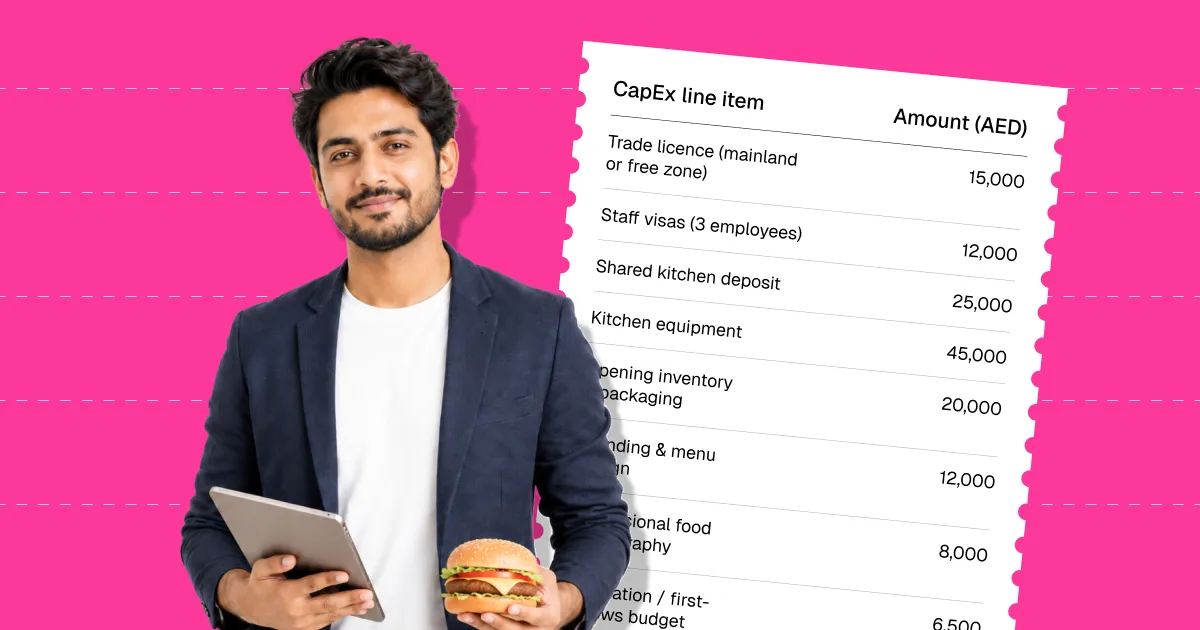
Startup requirements typically include company formation and licensing costs, kitchen deposit and rent commitments, fit-out or adaptation work, equipment, smallwares, initial inventory, packaging, brand development, photography, technology, and pre-opening payroll. The exact requirements vary by emirate, facility type, legal structure, and whether the business operates from a shared kitchen, a private unit, or an existing restaurant kitchen.
Monthly operating costs should include rent, utilities, labor, ingredients, packaging, platform commissions, payment fees where applicable, marketing support, cleaning, maintenance, and a realistic allowance for refunds, remakes, and waste. A financial blueprint should also account for working capital. Suppliers, payroll, rent, and platform payment cycles do not always align.
The critical output is not only projected sales. It is contribution margin per order and the sales volume required to cover fixed costs.
A practical model should test at least three scenarios: a controlled base case, a slower ramp-up case, and a strong-performance case. The slower case matters most because it shows how much capital the business needs if rankings, ratings, or repeat orders take longer to build than planned.
Licensing should be addressed early because the kitchen model and activity structure affect what can be approved, where the business can operate, and how it can trade. Requirements vary across the UAE and may involve commercial licensing, food safety approvals, tenancy documentation, facility approvals, and staff compliance processes.
The right site is not simply the cheapest available kitchen. It needs to support the intended delivery zones, operating hours, production requirements, storage needs, and compliance standards. A location outside the strongest customer radius may reduce rent, but it can create longer delivery times and weaken food quality at the doorstep.
Shared cloud kitchens can lower upfront investment and accelerate launch, particularly for a first brand. Private facilities may provide more control over layout, capacity, and brand operations. Existing restaurants can use unused kitchen capacity to launch virtual brands with lower incremental capital. Each route has different control, cost, and scalability trade-offs.
Delivery platforms are not passive sales channels. Their rankings and conversion depend on operational signals such as availability, preparation time, acceptance behavior, order accuracy, customer ratings, menu quality, promotional strategy, and the consistency of the customer experience.
A feasibility study should define how the new brand will gain its first orders and protect performance once it is live. This includes menu architecture for marketplace browsing, product photography requirements, opening-hour coverage, launch promotions, packaging standards, and a process for responding to rating issues.
Do not base the forecast on permanent discounting. Promotions can support customer acquisition, but a brand that only sells when discounted has not established viable demand. The commercial plan should show how pricing, repeat orders, and operational execution will gradually reduce reliance on paid visibility and deep offers.
The value of a feasibility study lies in its ability to produce clear go, revise, or stop decisions. Before launch, founders should establish the conditions that must be met: a target contribution margin, a maximum rent-to-sales ratio, a workable break-even order volume, a defined cash runway, and a production plan that protects service during peak periods.
If the numbers do not work, the right response may be to change the kitchen zone, reduce the menu, adjust the price architecture, use an existing restaurant kitchen, or postpone launch. Stopping a weak model before signing a long commitment is a commercial success, not a failure.
FoodWork approaches feasibility as the first stage of accountable execution: a structured assessment that connects financial assumptions to licensing, kitchen operations, and delivery-platform performance. The goal is not to make a concept look attractive on paper. It is to make the next decision controlled and defensible.
A strong feasibility study should leave the founder with a practical operating position: what to launch, where to launch it, how much capital is required, what performance level is needed, and which assumptions must be monitored from the first week of trading. That clarity gives a delivery business the discipline to improve before small operational gaps become permanent costs.
A useful cloud kitchen feasibility study makes a recommendation and states the conditions attached to it. It names the volume the site must reach, the price the menu must hold and the operating standards required, so performance can be measured against the plan rather than against hope.
It also tests the downside honestly. Any model looks attractive at full forecast. The value comes from knowing what happens in a slow quarter and whether the business survives it. Licensing and premises requirements referenced in the study should follow the published standards of the relevant authority, such as Dubai Municipality for food establishments in Dubai.
You can size the launch budget first with our setup cost calculator, then commission a full feasibility analysis and financial blueprint.
Demand evidence, location analysis, licensing route and timeline, capex and opex, menu contribution, volume scenarios, break-even and a risk register with mitigations.
Typically two to four weeks depending on data availability and how many locations or concepts are compared.
You can build a first version with platform data and supplier quotes. Independent review matters most where assumptions drive the decision, such as volume forecasts and pricing.
Several scenarios. A single forecast is a guess, while conservative, base and upside cases show whether the business survives a slow start.
Yes. Investors and lenders respond to modelled unit economics, a clear capital requirement and a stated break-even, far more than to concept descriptions.
When contribution cannot cover fixed costs at realistic volume, when the licensing route is blocked, or when the required price is out of line with the area.
Commission a feasibility analysis and financial blueprint, or start with the free setup cost calculator.
Get clarity before you commit capital.

+971 52 288 5400
2101, Court Tower, Business Bay, Dubai UAE
hello@foodwork.ae
© 2026 FoodWork. All rights reserved
