
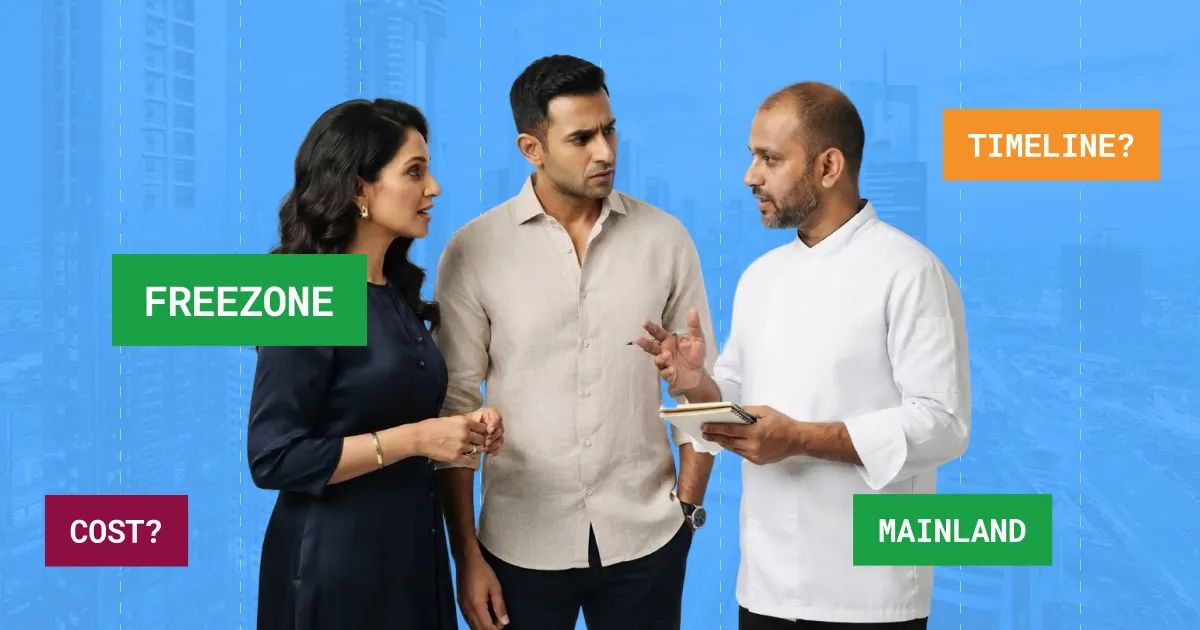
To open a cloud kitchen in Dubai you need three things in the right order: a trade licence with a food activity, a kitchen unit the authorities will approve for food production, and food safety clearance for the premises and the team. Everything else follows from those.
Starting a cloud kitchen in Dubai is no longer a niche idea. It has become one of the most common entry points into the food business for founders, investors, and first-time operators. Lower upfront costs, faster launch timelines, and platform-driven demand make the model attractive.
But one decision shapes everything that follows. Where you set it up.
Choosing between a Free Zone and the Mainland is not a paperwork formality. It directly affects cost, control, vendor complexity, and how smoothly your cloud kitchen actually launches.
This guide breaks down how cloud kitchens work across different zones in Dubai, what the real costs look like, and what most people only discover after committing money.
When people search for cloud kitchen Dubai or open cloud kitchen in Dubai, they usually focus on cuisine ideas or delivery platforms. The more critical decision comes earlier.
Your licensing zone determines
A poorly chosen structure increases cost and delays, even if demand is strong.
Free Zones are often the first option founders explore because of their simplicity and lower entry barrier.
A Free Zone cloud kitchen setup usually involves
Many Free Zones promote fast digital licensing, which reduces initial setup time. For founders who want to validate an idea quickly, this can be attractive.
Licensing costs generally start lower than the Mainland. Depending on the Free Zone, a basic food-related license can start from around AED 12,500. Fast-track options increase the cost slightly but reduce waiting time.
Visa costs are usually added per person and range between AED 3,750 and AED 5,000, depending on the package and processing speed.
Kitchen space is not included. You must rent a licensed commercial kitchen separately. Kitchen space in Dubai varies widely based on location, size, and services included. Shared or managed kitchens can range from AED 8,000 to AED 25,000 per month.
The key advantage is speed and clarity. The limitation is that operations depend heavily on third-party kitchen providers.
Mainland setups are more complex but offer greater operational flexibility in the long term.
A Mainland cloud kitchen license is issued by Dubai’s Department of Economy and Tourism. This structure is often preferred by operators planning to scale, add brands, or eventually expand into dine-in or catering.
Mainland setups allow
However, licensing costs are generally higher, and the approval process involves more steps.
Mainland licenses typically cost more than Free Zone licenses once all approvals are included. The exact amount varies depending on activity type and municipality requirements.
Visa costs are similar to Free Zones but may involve additional administrative steps.
Kitchen space for rent on the Mainland often provides more choice. You can lease independent kitchens, warehouse-style kitchens, or purpose-built cloud kitchen facilities. This flexibility can improve margins but increases setup responsibility.
For founders who want control and long-term scalability, the Mainland often makes sense despite higher initial complexity.
Regardless of Free Zone or Mainland, kitchen space is where most operational issues begin.
Kitchen space in Dubai is not just about rent. It affects
Kitchen space for rent may look affordable at first, but hidden costs appear quickly. Shared kitchens reduce upfront investment but limit control. Independent kitchens offer control but require higher capital and operational discipline.
Many founders choose a kitchen based on availability instead of delivery demand. This mistake is difficult to correct later.
Setting up a cloud kitchen involves more vendors than most founders expect.
Licensing agents, kitchen providers, equipment suppliers, food suppliers, staffing agencies, POS vendors, and delivery platforms all operate independently.
In a Free Zone setup, vendor coordination becomes even more critical because licensing and kitchen operations are handled by separate entities. On the Mainland, approvals may be more integrated, but execution responsibility still falls on the founder.
Without a single execution owner, timelines slip and costs rise. Founders end up managing vendors instead of building the business.
There is no universally correct answer. The right structure depends on your objective.
Free Zones work well for
Mainland setups suit
What matters is aligning the structure with your growth plan, not choosing based on the lowest headline cost.
Many people underestimate how much coordination is required to open a cloud kitchen in Dubai.
Licensing alone does not make you operational. Kitchen readiness, menu engineering, staffing, and platform onboarding must all align. A delay in one area affects everything else.
This is why many cloud kitchens bleed cash before their first stable month, even when demand exists.
Starting a cloud kitchen in Dubai is a real opportunity, but it is not a shortcut business.
Choosing between Free Zone and Mainland impacts cost, speed, and control. Kitchen space in Dubai determines margins more than branding. Vendor management often decides whether the launch is smooth or chaotic.
If you plan to open a cloud kitchen in Dubai, the smartest approach is to design the structure before committing money, not after problems appear.
The model rewards founders who plan execution as carefully as the menu.
Mainland licensing through Dubai Economy and Tourism suits operators who want to trade widely across the emirate and work directly with local suppliers and platforms. Free zone structures can offer ownership and cost advantages, but the activity must permit food production and the kitchen still needs municipality food safety approval.
The practical test is where you will produce and how you will sell. Delivery platforms serve customers by area, so the kitchen location matters more to revenue than the licensing jurisdiction does. Published requirements for food establishments are available from Dubai Municipality.
Size the budget with our setup cost calculator, and see current licence requirements in our guide to cloud kitchen licence requirements in Dubai.
Not necessarily. Both mainland and free zone routes are used, provided the licence permits food production and the kitchen holds municipality food safety approval.
It depends on kitchen type, equipment and how much work is outsourced. Model licence, approvals, kitchen, equipment, staffing and go-live separately, then add working capital.
A fitted, approved kitchen can trade within weeks. A shell unit usually takes several months once licensing, fit-out and equipment lead times are sequenced.
Yes, and most first-time founders do. Shared kitchens remove fit-out capital and shorten approvals, which lowers both cost and risk.
Yes, provided production capacity holds at peak and each brand is registered correctly on the delivery platforms.
Signing a lease before confirming the unit can be approved for food production, which leaves rent running while upgrades are negotiated.
Our end-to-end cloud kitchen setup handles the full sequence in Dubai, from licence to first order.
Get clarity before you commit capital.

+971 52 288 5400
2101, Court Tower, Business Bay, Dubai UAE
hello@foodwork.ae
© 2026 FoodWork. All rights reserved
