
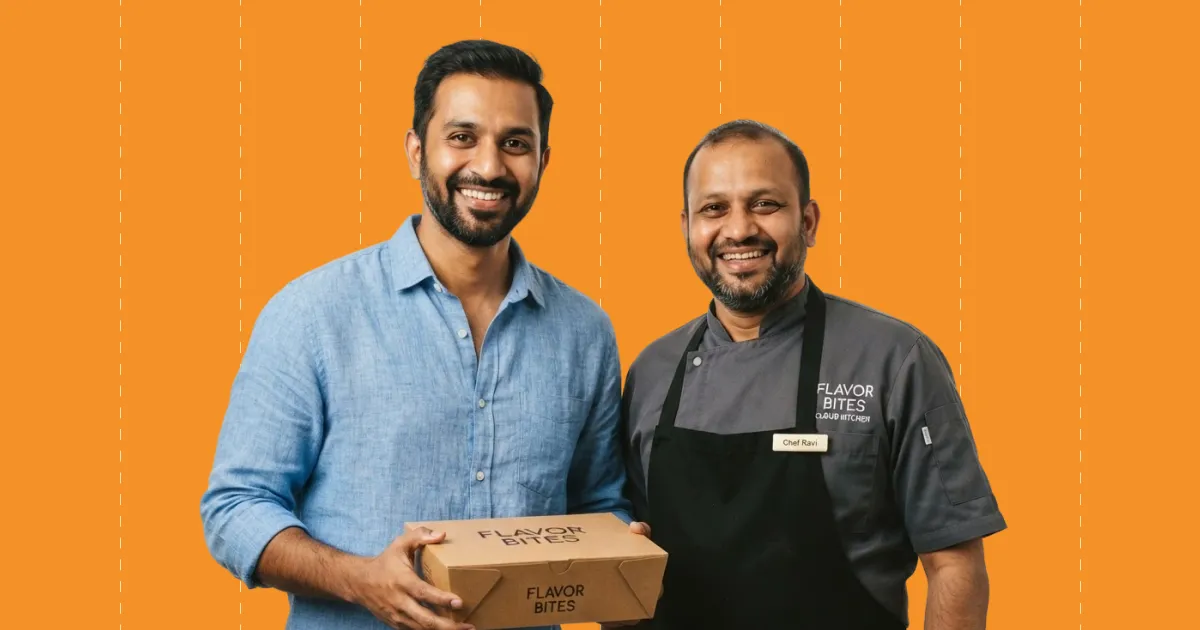
A cloud kitchen in UAE succeeds on four things: validated demand in the area it serves, a menu priced for delivery economics, operations that hold ratings above 4.3, and disciplined use of promotions. Concepts fail far more often on execution than on idea.
The cloud kitchen model looks simple from the outside. No dining area, lower upfront costs, delivery platforms bringing customers to your door. On paper, it feels like the fastest way to enter the food business in the UAE.
In reality, a cloud kitchen is one of the most execution-sensitive food models in the market.
This is why many cloud kitchens in the UAE struggle or shut down within months. Not because demand is missing, but because the business is treated as a shortcut instead of a system.
This blog explains how cloud kitchens really work in the UAE, what separates profitable operations from failing ones, and what you need to get right before you launch.
The UAE is structurally built for delivery-first food businesses.
Consumers in Dubai and Abu Dhabi are already trained to order food online. Delivery platforms are deeply integrated into daily life. High rental costs make traditional dine-in formats risky, especially for first-time founders. Add a population that is open to trying new cuisines, and the cloud kitchen model becomes a logical choice.
This is why interest in cloud kitchen in Dubai, cloud kitchen Abu Dhabi, and cloud kitchen in UAE keeps rising.
But demand alone does not protect you from poor execution.
A cloud kitchen is not just a kitchen without seating. It is a production unit designed around speed, consistency, and margins.
Orders come through platforms like Talabat and Deliveroo. Food is prepared in a compact kitchen, packed quickly, and dispatched within strict time windows. Ratings, preparation time, cancellation rate, and menu performance directly impact visibility and revenue.
A Talabat cloud kitchen behaves differently from a Deliveroo cloud kitchen. Pricing sensitivity, customer expectations, and menu performance vary by platform. Treating all platforms the same is one of the fastest ways to lose traction.
This is not a hospitality business in the traditional sense. It is an operational business.
Most cloud kitchen failures happen early, often before the brand has a fair chance to perform.
The first issue is fragmented setup. Licensing is handled by one party, kitchen sourcing by another, menu design by someone else, staffing by trial and error. No single person owns the full outcome. When delays or cost overruns happen, founders absorb the damage.
The second issue is weak unit economics. Menus are created without accounting for delivery commissions, packaging, wastage, and prep time. What looks profitable on paper collapses once real orders start flowing.
The third issue is launch delay. Every extra week before going live means rent, salaries, and utilities without revenue. Many cloud kitchens bleed cash before their first stable month.
These problems are common across every cloud kitchen setup gone wrong in the UAE.
While both cities offer opportunity, they demand different execution strategies.
A cloud kitchen in Dubai operates in a high-competition environment. Demand is strong, but so is supply. Visibility on delivery platforms is volatile. Speed, ratings, and menu positioning matter from day one. Kitchen rent is higher, and mistakes are punished quickly.
A cloud kitchen Abu Dhabi setup often benefits from slightly lower competition and more predictable demand. Customer loyalty tends to be stronger, but kitchen availability is more limited. Execution still matters, but stability is easier to achieve once operations are controlled.
Copying a Dubai strategy into Abu Dhabi, or vice versa, often leads to avoidable losses.
A sustainable cloud kitchen setup starts long before you touch a kitchen.
It begins with feasibility. This means understanding who you are selling to, how often they order, and what price points actually work after commissions and costs. Many concepts fail simply because no one stress-tested the numbers before committing capital.
Licensing and compliance come next. Choosing the wrong license or missing approvals can delay launch and limit operations later. Fixing these mistakes after setup is expensive and time-consuming.
Kitchen selection is not about the cheapest rent. It is about delivery radius, order density, layout efficiency, and scalability. A poorly chosen kitchen can quietly kill margins even if sales look healthy.
Menu engineering is where most cloud kitchens lose money. Too many items, slow prep, poor travel quality, or inconsistent portions all hurt ratings and profitability. The menu must be designed for delivery behavior, not personal preference.
Staffing and SOPs define whether the business is stable or chaotic. Without clear processes, quality depends on individuals, and consistency disappears the moment someone leaves.
Technology ties everything together. POS systems, order flow, and delivery platform integration must be set up correctly to avoid bottlenecks, missed orders, and penalties.
Only after these foundations are in place does launch make sense.
A Talabat cloud kitchen or Deliveroo cloud kitchen does not succeed by simply being listed.
Visibility depends on operational performance. Late orders, low ratings, menu downtime, and cancellations push brands down the ranking. Recovery is slow and expensive.
Founders often underestimate how quickly platforms penalize inconsistency. Early mistakes have long-term consequences.
This is why launch support and early optimization matter just as much as setup.
Who Should Consider a Cloud Kitchen in UAE
A cloud kitchen in the UAE is well-suited for first-time founders who want a controlled entry into F&B, restaurant brands expanding delivery-only concepts, and investors looking for asset-light food businesses.
It is not ideal for anyone expecting passive income or a hands-off operation. Cloud kitchens demand daily discipline, data-driven decisions, and tight cost control.
The biggest difference between successful and failing cloud kitchens is not the idea. It is ownership of execution.
When one team owns feasibility, setup, launch, and early operations, decisions stay aligned. Costs are controlled. Delays are minimized. Accountability is clear.
This is why FoodWork exists. Not as a consultant that gives advice and exits, but as an execution partner that stays involved until the kitchen is live, stable, and operating in the real world.
The cloud kitchen model in the UAE is proven. Demand is real. Platforms are mature. The opportunity exists.
But success is not automatic.
Whether you are planning a cloud kitchen in Dubai, a cloud kitchen Abu Dhabi, or entering the market anywhere else in the UAE, the outcome depends on how well you plan, build, and launch.
Cloud kitchens reward structure, speed, and discipline.
They punish fragmentation and guesswork.
If you approach setup with clarity and execution ownership, the model works.
The common pattern is a strong concept, a rushed launch and no operating rhythm. Menus copied from dine-in lose margin to commission. Preparation times set optimistically create late orders. Stock outs at peak trigger cancellations. Within three months, ratings fall, visibility drops, and the response is usually a discount, which accelerates the problem.
The operators who scale in the UAE build the rhythm first: prep against par levels, cook to promise times, pack at a dedicated station, mark availability honestly and review the numbers weekly with the kitchen team present.
Licensing requirements for food establishments are published by Dubai Municipality, and you can size a launch budget with our setup cost calculator.
It can be, when contribution per order covers fixed costs at realistic volume. Profitability depends on menu pricing, commission, packaging and rating stability rather than on rent alone.
A licensed shared or managed kitchen. It removes fit-out capital and approval delay, which is why most first-time founders begin there.
Start with the platforms that dominate your area, then expand. Each additional listing adds operational load, so add them deliberately rather than all at once.
Critical. Ratings influence both visibility and conversion, and a listing below 4.0 usually needs discounting to maintain volume, which erodes margin.
As many as production can hold at peak without slowing dispatch. Complexity, not licensing, is the practical constraint.
Validate demand, confirm the premises can be approved for food production, and model contribution per item at conservative volumes.
Talk to FoodWork about end-to-end setup or managed operations for a UAE cloud kitchen launch.
Get clarity before you commit capital.

+971 52 288 5400
2101, Court Tower, Business Bay, Dubai UAE
hello@foodwork.ae
© 2026 FoodWork. All rights reserved
